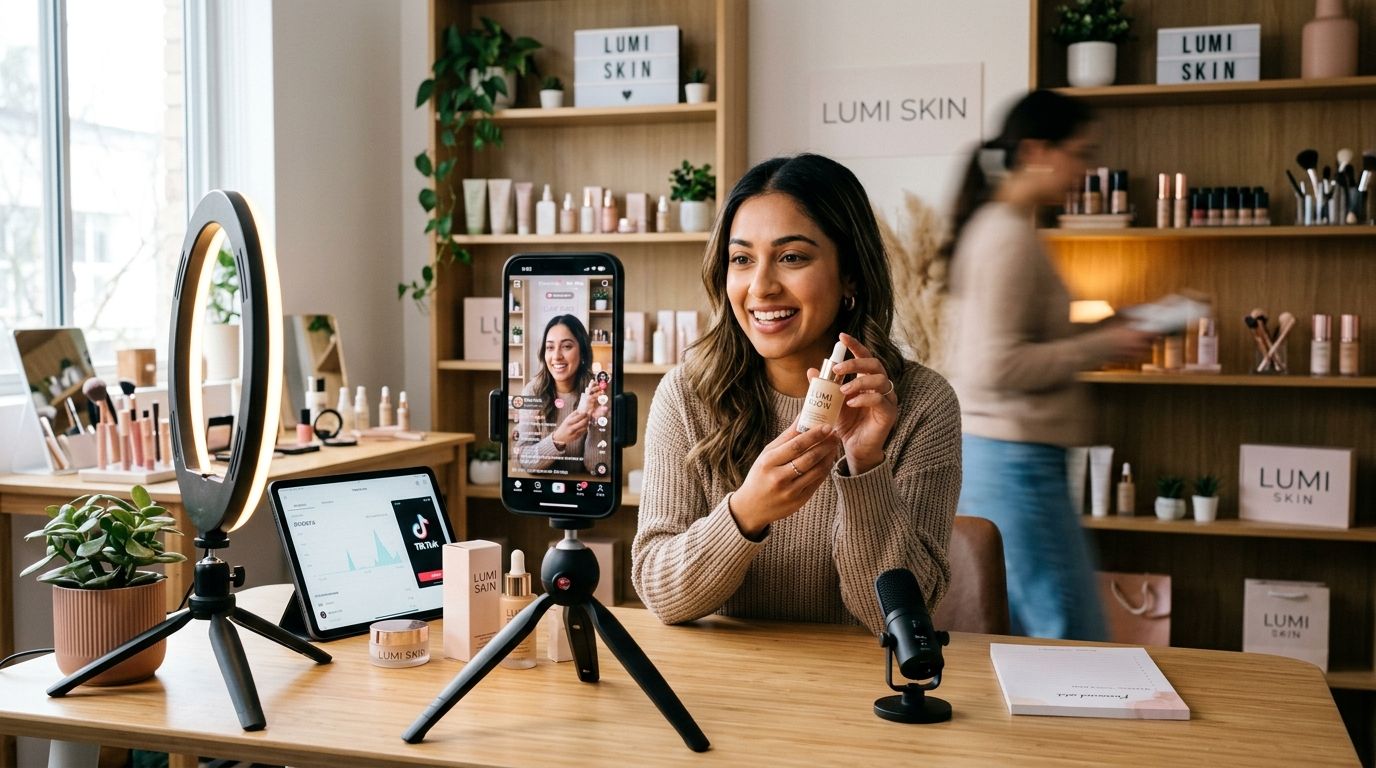
Indie beauty brands don't lose to bigger competitors on product quality. They lose on content systems — posting without a plan, chasing platforms instead of building assets that compound.
- Founder-led video and UGC density beat polished brand campaigns for indie beauty brands in 2026 — prioritize both.
- A 90-day content sprint with one hero asset repurposed into 8-10 formats outperforms scattered daily posting.
- Content marketing for indie beauty brands works only when SEO, email, and paid share the same content calendar.
- Skip generic AI blog spam and one-off viral chasing — neither builds owned audience or search equity.
Why this matters
Most indie beauty founders treat content as a volume game: more posts, more platforms, more noise. That's backwards. The brands scaling past $1M in 2026 run content as a system where every asset feeds the next channel — a founder video becomes a Reel, a Reel becomes an email subject line, an email becomes ad creative.
The Darl builds these ecosystems for consumer and beauty brands specifically because single-channel content dies fast and costs more per result every quarter. If your content marketing for indie beauty brands isn't tied to a repurposing engine, you're paying for reach you can't reuse.
Who this is for
This guide is built for indie beauty founders and small marketing teams — usually one to three people — running a DTC or Sephora/Ulta-adjacent brand with a real product but no content playbook. You're likely producing content reactively, chasing whatever platform trend showed up this week, and you don't have the budget to run five channels as five separate strategies.
What to look for in content marketing for indie beauty brands
Founder-led storytelling weight
Indie beauty buyers convert on trust, and trust comes from a face, not a logo. A founder explaining why a formula exists — the failed batch, the ingredient swap, the regulatory fight — outperforms studio-shot product content because it can't be faked by a bigger competitor with a bigger budget.
UGC and community proof density
One polished campaign video reads like an ad. Twenty customer clips, even shaky ones, read like proof. Indie beauty brands need a steady pipeline of real-customer content because social proof is the fastest trust shortcut left in a crowded feed.
SEO-backed evergreen content mix
Social content decays in 48 hours. A well-built ingredient education page or routine guide keeps ranking and converting for years. Indie brands that skip SEO entirely are rebuilding their audience from zero every single week.
A repurposing engine across channels
If every piece of content is made once and used once, your cost-per-asset never improves. The brands winning in 2026 turn one hero video into a blog excerpt, three Reels, an email series, and two ad variants — same production cost, five times the output.
Email and SMS content tie-in
Most indie beauty brands treat email as a discount blaster instead of a content channel. Routine tips, ingredient deep-dives, and behind-the-scenes updates in email keep the list engaged between purchases and feed your paid retargeting audiences fresh creative.
Paid social content compatibility
Content built only for organic reach rarely performs as an ad. Build with paid in mind from day one — hook in the first three seconds, product visible by second five — and every organic post becomes a testable ad candidate.
The tactics that actually move indie beauty brands
Founder-led video diaries — the safe pick
One weekly video, 60-90 seconds, founder talking directly to camera about product development, ingredient sourcing, or customer questions. The spec that matters: consistency, not production value — a 90-day run of weekly founder videos builds recognizable presence faster than a single high-budget shoot. Verdict: Buy.
Community and Reddit-style seeding — the wildcard
Seeding genuine product conversations in beauty-adjacent communities (skincare subreddits, niche Discords, ingredient-focused forums) drives discovery that ads can't buy. The catch: it takes real participation, not drop-and-run posting, over a 60-day minimum window to build any credibility. Verdict: Consider.
SEO ingredient and routine hub — the compounding pick
A blog structured around ingredient education and routine-building content compounds monthly organic traffic instead of resetting to zero every week like social. Indie brands that commit to 2-4 published pages a month for six straight months typically see the first meaningful organic lift by month four. Verdict: Buy.
Email content series — the retention pick
A structured 5-email welcome series covering ingredient story, usage routine, and social proof outperforms a single discount-code welcome email on repeat purchase behavior. Verdict: Buy.
UGC-to-ad creative testing — the paid amplifier
Taking raw customer clips and running them as ad creative, unedited or lightly edited, tests faster and cheaper than commissioned content. Run 4-6 UGC variants per week against your best-performing organic post as the control. Verdict: Consider.
Build a content system, not a content pile
See how an omnichannel content strategy fits your beauty brand.
What to avoid
- Generic AI-generated blog posts with no ingredient or brand specificity. They look like content but rank for nothing and read like every competitor's copy because they are.
- One-off influencer packages without usage rights. A single viral moment with no rights to repost the content leaves you with a spike and nothing to repurpose.
- Chasing every new platform feature. Indie beauty brands with three people on the team can't run TikTok, Instagram, Pinterest, and YouTube Shorts as five different strategies — pick two and build the repurposing engine first.
“If a piece of content only works on the platform it was made for, it's not a content strategy, it's a post.”
Verdict comparison
| Tactic | Best for | Time to results | Verdict |
|---|---|---|---|
| Founder-led video diaries | Trust building | 90 days | Buy |
| Community/Reddit seeding | Discovery | 60 days | Consider |
| SEO ingredient hub | Compounding organic traffic | 4-6 months | Buy |
| Email content series | Retention | 30 days | Buy |
| UGC-to-ad testing | Paid efficiency | 2-4 weeks | Consider |
FAQ
What's the best content marketing strategy for indie beauty brands in 2026?
The best approach combines founder-led video, UGC, and SEO-backed evergreen content run through a single repurposing engine. Indie beauty brands that treat channels as separate silos in 2026 spend more per result than brands running one connected system.
Is SEO worth it for a small indie beauty brand?
Yes, SEO content compounds while social content decays within 48 hours. A brand publishing 2-4 ingredient or routine pages a month typically sees measurable organic lift by month four.
How often should indie beauty brands post content?
Consistency matters more than volume — one weekly founder video sustained for 90 days builds more recognition than daily posting for two weeks. Set a cadence you can hold for a full quarter before adding channels.
Should indie beauty brands use influencers or UGC?
UGC generally outperforms paid influencer content on trust and repurposing value because it reads as proof rather than an ad. Reserve influencer spend for reach, and secure usage rights so the content can be reused as ad creative.
How much content should come from the founder versus the team?
Founder-led content should anchor the trust-building layer — weekly video, ingredient stories, product decisions — while the team handles repurposing into Reels, email, and ad variants. This split keeps production sustainable without losing the personal voice.
Can content marketing replace paid ads for an indie beauty brand?
No, content and paid work together, not as substitutes. Organic content built with paid in mind — clear hooks, product visible early — becomes testable ad creative, cutting cost-per-acquisition versus content made for only one channel.
What's the biggest content mistake indie beauty brands make?
Treating each platform as a separate strategy instead of one asset repurposed across channels. This multiplies production cost without multiplying results, which is the fastest way to burn a small team's bandwidth.
How long before content marketing shows results for a beauty brand?
Email and UGC-to-ad tactics can show results in 2-4 weeks, while SEO content typically needs 4-6 months to compound. Run both timelines in parallel rather than waiting on one before starting the other.
One last thing
The indie beauty brands still standing in 2026 aren't the ones posting the most — they're the ones who turned one good piece of content into five channels' worth of material without touching the camera twice. Build the repurposing engine before you build the posting calendar, and content marketing for indie beauty brands stops feeling like a treadmill.