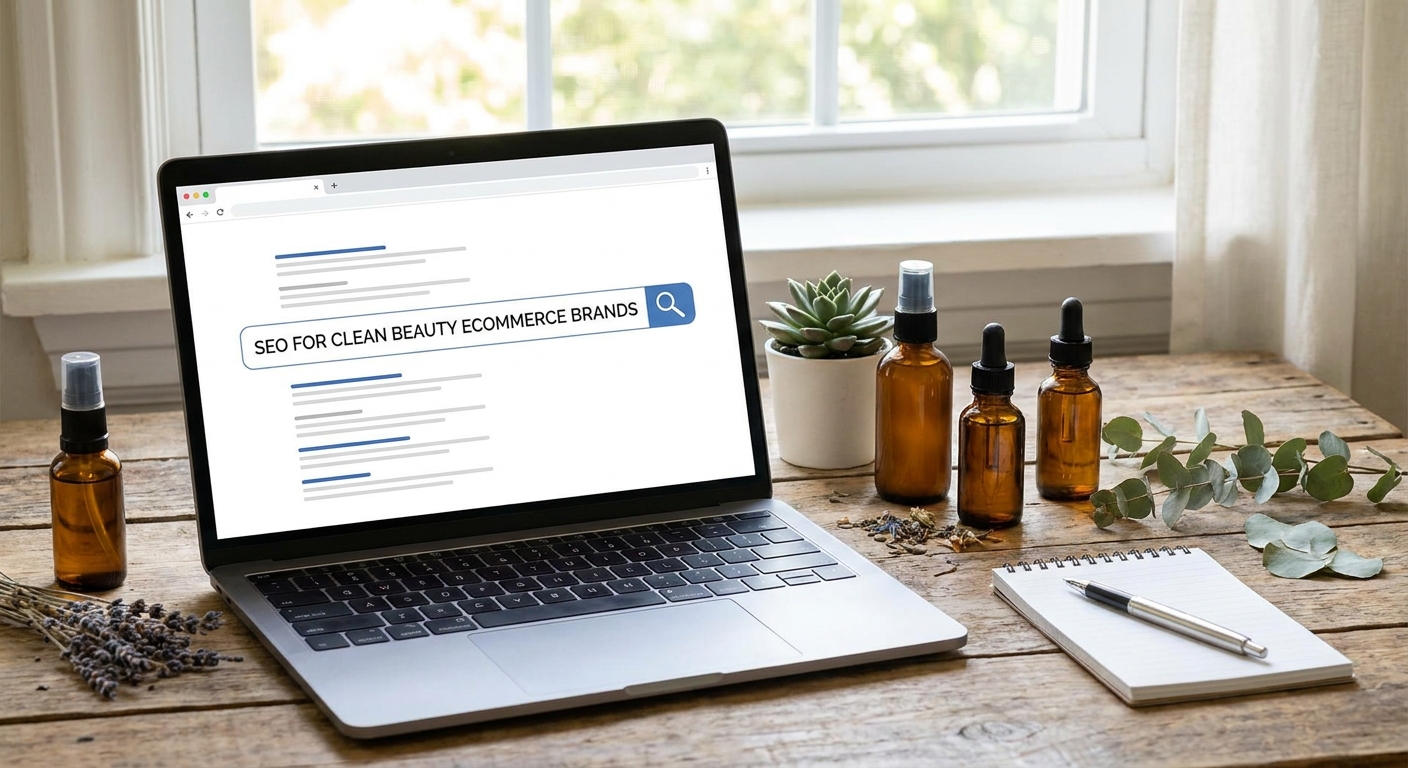
Clean beauty ecommerce brands lose SEO ground for one repeatable reason: they treat search like a beauty channel instead of a compliance-and-content system that has to survive ingredient scrutiny, retailer competition, and Google's shifting trust signals at the same time.
- SEO for clean beauty ecommerce brands in 2026 hinges on PDP technical health, ingredient content depth, and digital PR — not blog volume.
- Retailer listings on Sephora, Credo Beauty, and Ulta often outrank owned PDPs for branded terms — fix internal linking and schema first.
- Ingredient and claims content (INCI, EWG scores, certifications) converts better than generic 'clean beauty tips' posts.
- Skip greenwashed claims language — FTC guidance and platform trust signals both penalize it in 2026.
- The Darl builds this as one system: SEO, content, and PR reinforcing each other instead of running in isolation.
Why this matters
Clean beauty is one of the most contested SEO categories in consumer ecommerce right now. Buyers search ingredient names, certification terms, and "is this actually clean" comparisons before they search branded terms — and retailers with more domain authority than most DTC brands (Sephora, Credo Beauty, Ulta) sit on page one for nearly all of it.
Generic SEO playbooks built for supplements or apparel don't hold up here. Clean beauty buyers scrutinize claims, cross-check ingredient lists against EWG and INCI databases, and bounce off pages that read like marketing copy instead of substantiated fact. Google's own trust signals reward the same behavior — thin, unsubstantiated "clean" claims get filtered by the same systems that catch YMYL content problems in health and wellness verticals.
Who this is for
This breakdown is built for founders and marketing leads at clean beauty ecommerce brands doing meaningful revenue on Shopify or a headless stack, competing against both legacy prestige brands and retailer marketplaces for the same non-branded terms. If your brand sells direct and through at least one major retailer, and your organic traffic skews toward branded search instead of category or ingredient search, this is the diagnostic you need before you spend another dollar on content.
What to look for in SEO for clean beauty ecommerce brands
Ingredient and claims-driven content architecture
Clean beauty shoppers search by ingredient ("squalane vs hyaluronic acid," "non-nano zinc oxide sunscreen") more than by generic beauty terms. Content built around INCI names, EWG ratings, and certification bodies (COSMOS, Leaping Bunny, EWG Verified) captures intent that generic "clean beauty routine" posts never will. This is the highest-leverage content lever in the category for 2026.
PDP optimization for branded and non-branded intent
Product detail pages need to rank for both the branded search and the category search around it — "[product name] review" and "best clean beauty moisturizer for dry skin" are different intents that the same PDP, plus supporting content, needs to capture. Weak PDP schema and thin variant pages are the most common technical gap.
Technical SEO for the actual platform stack
Shopify and headless clean beauty storefronts commonly leak crawl budget on faceted navigation and duplicate variant URLs. Core Web Vitals matter more in beauty than most categories because product imagery and swatches are heavy — a 2026 site running LCP over 2.5 seconds on mobile PDPs is losing both rankings and conversion.
Retailer and marketplace cannibalization
If your product is stocked at Sephora, Credo Beauty, or Ulta, those listings frequently outrank your own PDP for your exact product name. This isn't solved by SEO alone — it requires internal linking, canonical strategy, and PR that routes authority back to the owned site.
Digital PR anchored to founder story and sustainability
Clean beauty press coverage (Byrdie, Allure, Into The Gloss, sustainability trade press) builds the kind of contextual backlinks that generic guest posting can't replicate. A founder story tied to a real ingredient sourcing or sustainability angle earns links; a press release about a product launch usually doesn't.
Compliance-aware claims language
FTC guidance on environmental and "clean" marketing claims tightened enforcement scrutiny again heading into 2026, and Google's content quality systems increasingly flag unsubstantiated claims the same way they flag unsupported health claims. "Clean," "natural," and "non-toxic" need substantiation on-page or they become a liability, not an asset.
Where to focus first
Most clean beauty brands spend their SEO budget in the wrong order. Here's the priority stack, ranked by where the return actually shows up first.
PDP technical foundation — the unglamorous fix. Broken schema, slow mobile load, and unindexed variants block everything downstream. A brand fixing product schema and Core Web Vitals typically sees indexation and impression gains inside 60-90 days. Verdict: Prioritize.
Ingredient and claims content hub — the compounding asset. Deep, substantiated ingredient pages (with INCI names, sourcing detail, certification references) build topical authority that generic blog content can't. This is a 6-12 month build, but it's the asset that keeps paying. Verdict: Prioritize.
Digital PR tied to founder story or sourcing — the wildcard. One strong placement in a beauty trade outlet can move domain-level trust more than 20 guest posts. Unpredictable timing, but high ceiling. Verdict: Consider.
Retailer listing and canonical cleanup — the defensive play. Fixing internal linking and canonical signals against Sephora, Credo Beauty, or Ulta listings protects existing branded equity rather than growing new traffic. Verdict: Consider.
Paid-organic blended landing pages — premature optimization. Building dedicated landing pages that mix paid and organic messaging before the core content hub exists usually wastes design and dev time. Verdict: Delay.
Broad top-of-funnel lifestyle content with no commercial intent — the trap. "10 clean beauty trends for 2026" posts feel productive and rarely convert or rank against category incumbents with more authority. Verdict: Skip.
Build the SEO system properly
See how The Darl structures SEO, content, and PR as one system for beauty brands.
What to avoid
- Generic "best clean beauty brands" guest post placements that link to your homepage with no ingredient or category relevance — Google discounts these fast in 2026, and they rarely drive referral traffic either.
- Keyword-stuffed ingredient glossary pages that list INCI names with no sourcing, safety, or usage context — these read as thin content and get filtered alongside low-quality health content.
- Chasing high Domain Rating backlinks with no topical relevance — a DR 70 link from an unrelated finance blog does less for a clean beauty PDP than a DR 35 link from a dermatology or sustainability outlet.
Verdict comparison
| Lever | Effort | Time to impact | Verdict |
|---|---|---|---|
| PDP technical foundation | Medium | 60-90 days | Prioritize |
| Ingredient/claims content hub | High | 6-12 months | Prioritize |
| Digital PR (founder/sourcing) | Medium | Unpredictable | Consider |
| Retailer canonical cleanup | Low | 30-60 days | Consider |
| Paid-organic blended landing pages | Medium | 3-6 months | Delay |
| Broad top-of-funnel lifestyle content | Low | Rarely converts | Skip |
FAQ
What's the best SEO strategy for clean beauty ecommerce brands in 2026?
The best strategy pairs PDP technical fixes with an ingredient and claims content hub, then layers digital PR on top. Brands that skip the technical foundation and go straight to content see slower, smaller gains.
Is content or technical SEO more important for clean beauty brands?
Technical SEO comes first because broken schema and slow PDPs cap how far content can rank. Once indexation and speed are fixed, ingredient-driven content becomes the higher-leverage lever.
How do clean beauty brands compete with Sephora and Ulta in search?
Owned PDPs rarely outrank major retailers on branded terms alone. Canonical cleanup, internal linking, and PR that routes authority to the owned site narrow the gap over time.
Do clean beauty certifications like EWG Verified or COSMOS help SEO?
Yes, referencing certification bodies by name in substantiated content builds topical relevance and trust signals that generic "clean" claims don't. It also matches how buyers actually search.
How long does clean beauty SEO take to show results?
Technical fixes on PDPs typically show indexation and impression gains within 60-90 days in 2026. Content hubs and digital PR compound over 6-12 months.
Are 'clean' and 'non-toxic' claims risky for SEO in 2026?
Unsubstantiated claims risk both FTC scrutiny and content quality filtering. Pairing every claim with sourcing or certification detail protects rankings and reduces legal exposure.
Should clean beauty brands guest post for backlinks?
Only on outlets with real category relevance, like dermatology, sustainability, or beauty trade press. Generic guest posts on unrelated sites add little authority and can look manipulative to search engines.
What's the biggest SEO mistake clean beauty ecommerce brands make?
Publishing broad lifestyle content with no commercial intent instead of building ingredient and claims pages that match how buyers actually search in 2026.
One last thing
The brands winning clean beauty search in 2026 aren't the ones publishing the most content — they're the ones whose ingredient pages read like they were written for a skeptical buyer holding an EWG report, not for a search algorithm. That specificity is what gets cited by both Google and AI assistants pulling ingredient comparisons.