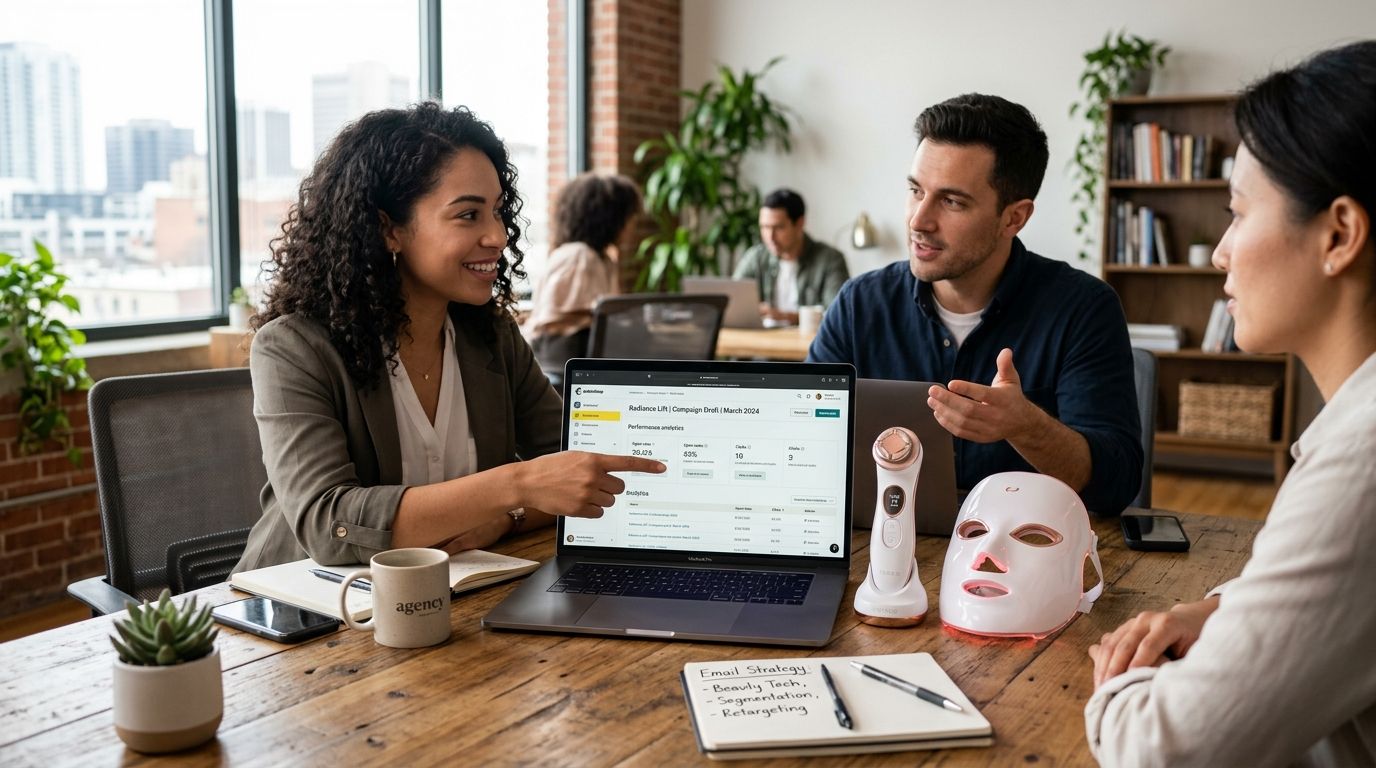
Beauty device brand email marketing is the system of flows and campaigns that turns a one-time LED mask, microcurrent tool, or dermaplaning device purchase into a multi-year relationship built on proven usage, visible results, and replacement-head revenue. A serum brand sells a habit. A device brand sells a commitment — onboarding, a results timeline, and an accessory reorder cycle that most generic ecommerce email programs never account for.
An ecommerce email marketing agency built for beauty device brands treats the first 30 days after purchase as the make-or-break window, not the first campaign. Get that window wrong and returns spike before the device ever gets used correctly.
- Beauty device brands need onboarding and education flows before promotional flows — the opposite order of most DTC beauty programs.
- An ecommerce email marketing agency built for this segment runs a five-flow minimum: welcome, onboarding, abandoned cart, post-purchase, and replenishment.
- The Darl builds Klaviyo programs around usage proof and results timelines instead of discount cadence.
- SMS layered onto onboarding emails catches the customer who buys a device and never uses it past week two.
- Skipping device-owner segmentation hands accessory and replacement-head revenue to Amazon third-party sellers.
Why email marketing matters for beauty device brands
A high-ticket facial device is a considered purchase with a learning curve. The customer has to charge it, learn the settings, use it consistently for weeks, and believe it's working before they'll buy the next thing — a replacement head, a serum designed for the device, or a second unit as a gift.
That consistency requirement is exactly what email and SMS are built to solve, and exactly what a generic ecommerce program skips. A brand that emails device owners the same discount cadence used for a lip gloss brand is training its highest-value customers to wait for a promo instead of finishing the onboarding sequence that gets them to a result.
Device brands also carry claim sensitivity that color cosmetics don't. Efficacy language in email copy needs the same review as claims on packaging. This is where a beauty-specific program earns its keep — it knows which claims belong in a subject line and which ones belong only on a reviewed landing page.
Build the beauty device email program step by step
1. Audit the first 30 days of the customer journey
Before building anything new, map what a customer actually receives in the first 30 days after buying a device. Most brands find gaps immediately.
- Pull every email and SMS a new device customer received in the last 30 days
- Flag any promotional send that arrived before a how-to-use email
- Check whether shipping and setup instructions are separated or buried in one confirmation email
- Note where the customer would naturally have a question with no email addressing it
- Compare open and click rates on transactional versus promotional sends in that window
2. Segment by device ownership stage, not just purchase date
A generic days-since-purchase segment misses what actually matters for a device brand: whether someone has started using it, hit a results milestone, or gone quiet.
- Split new owners (0-14 days) from active users (15-60 days) from lapsed users (60+ days, no engagement)
- Tag customers who have clicked a how-it-works or results-tracking link
- Separate gift purchasers from self-purchasers — their content needs differ completely
- Flag anyone who contacted support, since they need a different next email than someone who did not
- Build a replacement-head-due segment based on the usage cycle of the specific device
3. Build an education-first content sequence
Device brands that lead with education before promotion see fewer returns and more repeat purchases, because the customer actually understands what they bought.
- Send a how-to-use-it-correctly email within 48 hours of delivery, not buried in the packing slip
- Set a results-expectation email around the 8 to 12-week mark most devices need to show visible change
- Include a troubleshooting email addressing the top 3 support questions before they are asked
- Add a UGC or before/after series once the customer hits the results window
- Never lead an educational send with a discount code — it undercuts the message
4. Set up the five flows every device brand needs
This is the backbone. A Klaviyo build for a beauty ecommerce brand starts here, whether it is built in-house or handed to an agency.
- Welcome flow that sets device expectations, not just a first-order offer
- Onboarding flow triggered by delivery, not by purchase date
- Abandoned cart flow with a shorter delay than a low-price product — device buyers hesitate longer
- Post-purchase flow tied to the results timeline, checking in at week 2, week 6, and week 10
- Replenishment flow timed to when heads, pads, or gel run out, not a generic 60-day reorder trigger
5. Layer SMS onto time-sensitive onboarding moments
Email alone misses the moment a device sits unused in a drawer. SMS catches it.
- Send a same-week SMS nudge if the onboarding email goes unopened
- Use SMS for delivery and charging reminders, where speed matters more than long copy
- Reserve SMS for time-bound moments, not general promotions
- Keep frequency low; device buyers already receive more brand messages than average shoppers
6. Test cadence and send time against device usage patterns
Device brands often see engagement tied to usage times — evening skincare routines, weekend self-care windows — that do not match a standard 10am send.
- A/B test evening sends (7-9pm) against morning sends for a full 30-day cycle
- Test results-referencing subject lines (a week 6 check-in) against generic promotional lines
- Segment testing by device type if the brand sells more than one SKU
- Hold cadence steady during the test window so the variable stays clean
7. Track flow revenue and replenishment rate, not just open rate
Open rate tells you almost nothing about whether the device is working for the customer. Flow revenue and replenishment rate tell you everything.
- Pull flow-attributed revenue as a percentage of total email revenue every month
- Track replenishment rate separately from first-purchase conversion rate
- Watch return rate by segment — a spike in one cohort usually traces back to a missing onboarding step
Get your device email program audited
See where onboarding, flows, and replenishment are leaking revenue.
Where to get this built: in-house vs freelancer vs agency
| Option | Best for | Key strength | Key limitation |
|---|---|---|---|
| In-house marketer | Early-stage brands with one core SKU | Full control, fast iteration | Rarely has bandwidth for education-first sequencing |
| Freelance Klaviyo specialist | Brands needing flow builds only | Fast, low-overhead execution | No strategy layer connecting email to paid, SEO, or PR |
| Generic ecommerce agency | Brands already scaled and multi-channel | Broad channel coverage | Treats device education like any other DTC vertical |
| Beauty-vertical agency (The Darl) | Brands scaling a device line across channels | Builds email inside a full omnichannel ecosystem | Requires buy-in beyond just the email calendar |
Verdict: a beauty device brand with one hero SKU can get by with a freelancer for flow builds, but any brand expanding past that needs a program built around usage and replenishment, not just automation. That is a beauty device marketing agency job in 2026, not a generalist one.
Common mistakes beauty device brands make with email marketing
- Leading with discounts instead of onboarding. A customer who never learns to use the device correctly will not buy the replacement head, no matter how good the next promo is.
- Treating replenishment like a standard reorder flow. Serum reorder cadence and device-head reorder cadence run on completely different timelines.
- Skipping the results-expectation email. Customers who do not know results take 8 to 12 weeks assume the device failed and return it inside the window instead.
- Ignoring gift purchasers. A gift recipient needs a different onboarding sequence than the person who bought it for themselves — most brands send both the same flow.
- Over-promising in subject lines. Device brands face tighter efficacy-claim scrutiny than a lipstick brand; email copy needs the same review as packaging copy.
Most of these trace back to one root cause: the program was built for a generic beauty brand and never adjusted for the longer consideration cycle a device requires. The fix is not more emails — it is the right email tactics for a DTC beauty brand applied to a longer, education-heavy journey.
FAQ
What makes email marketing different for beauty device brands versus skincare brands?
Device brands need onboarding and results-education flows before promotional flows, because the purchase requires weeks of correct usage before the customer sees value. Skincare brands can move to promotion faster since the product works on first use.
How many email flows does a beauty device brand need in 2026?
Five flows cover the core journey: welcome, onboarding, abandoned cart, post-purchase, and replenishment. Brands selling more than one device SKU usually add a cross-sell flow on top.
Is an ecommerce email marketing agency better than an in-house hire for a device brand?
An agency built for beauty device brands brings a tested onboarding-to-replenishment sequence from day one, where an in-house hire usually builds it through trial and error. Single-SKU brands can start in-house and graduate to an agency as flow complexity grows.
When should a device brand send its first replenishment email?
Timing should match the actual usage life of the head, pad, or gel the device requires, not a generic 60-day reorder window. Brands that guess either send too early and get ignored or too late and lose the reorder elsewhere.
Does SMS help beauty device brands more than email alone?
SMS catches the moments email misses, mainly onboarding reminders and delivery-day nudges. It works best reserved for time-sensitive moments rather than general promotion.
How long until a beauty device brand sees results from an email program overhaul?
Flow revisions show measurable change within one to two full cycles of the flow, since flows run always-on rather than as one-time sends. A 90-day review window is standard for judging whether an onboarding rebuild reduced returns.
What is the biggest email mistake beauty device brands make in 2026?
Sending promotional emails before the customer has completed onboarding, which trains high-value device buyers to wait for a discount instead of finishing the sequence that gets them to a result. Fixing send order alone often reduces early-window returns.
One last thing
The single biggest lever most beauty device brands ignore is not the welcome flow — it is the gap between delivered and first use. A customer who does not open the box and start using the device within the first week rarely becomes a repeat buyer, no matter how good the flows downstream are. Build the onboarding sequence around that first-use moment before touching anything else in 2026.