Beauty launches live or die on what happens in the room — and what survives after the room empties. Get event marketing for beauty brand launches right and you walk away with sell-through, earned press, and a content library that fuels paid and organic for months. Get it wrong and you paid for one good photo and a bar tab.
- A launch dinner of 30-50 press and influencers outperforms a 200-person party for earned reach — buy that format first.
- Event marketing for beauty brand launches fails without a follow-up email sequence live within 48 hours — build it before the invite goes out.
- Pop-up activations that run 3-5 days generate more usable content than a single-night event — consider this for retail-adjacent brands.
- Virtual-only launches skip the content capture problem entirely but underperform on earned media for prestige positioning — skip unless budget forces it.
Why this matters
A launch event has one real job in 2026: prove the brand exists before the algorithm decides whether to amplify it. Retailers, press, and influencers all move faster when they've stood in a room with the product before the drop date.
Most beauty founders treat the event as the deliverable. It isn't. The event is a content shoot with an open bar. If nobody captured usable footage, if the follow-up email didn't go out inside 48 hours, if the guest list was picked for vibes instead of reach — the launch cost money and returned nothing measurable.
Brand strategy work for prestige positioning determines the guest list and the room before a single vendor gets booked, which is why brand strategy for prestige beauty brands has to happen before the event calendar, not after.
Who this is for
This guide is for founders and marketing leads launching a new SKU, a full brand, or a category extension in 2026 with a budget between $15,000 and $150,000 for the activation. If you're bootstrapped and shipping via DTC only with no press list, most of this scales down but the follow-up sequence rules still apply. If you're backed and prepping a Sephora or Ulta shelf placement, the guest list and content capture rules matter more, not less.
What to look for in event marketing for beauty brand launches
Content capture built into the run of show
Hire a photographer and one video person minimum, and script the shot list before the event, not during it. A launch without a shot list produces 40 phone photos and zero usable brand assets for the next quarter of paid and organic content.
A guest list built for earned reach, not headcount
Thirty press and micro-to-mid influencers who post beat 150 randoms who show up for the free product. Reach compounds through who's in the room, not how many chairs are filled.
A follow-up sequence live within 48 hours
Every attendee who didn't buy on-site needs an email or SMS touch inside two days, while the event is still top of mind. Miss that window and the intent decays fast — most guests forget the product name by the following weekend.
A format that matches the price point
A $28 lip product doesn't need a $80,000 gala. A $180 serum launch undersells itself at a rooftop happy hour with a cash bar. Match the room to the retail price or the disconnect reads as inauthentic to press covering it.
Measurement tied to sales lift, not attendance
Track a unique promo code, a landing page with UTM tagging, and a 30-day sell-through comparison against a control SKU. Headcount and Instagram Story views are vanity numbers that don't answer whether the launch moved product.
Top picks: event formats that work for beauty launches
The safe pick: press-and-influencer preview dinner
Cap it at 30-50 guests, seated, with a structured tasting or demo moment built into the menu or run of show. This format consistently produces the highest ratio of earned coverage per dollar spent because every guest has a reason to talk about the product beyond "free stuff." Verdict: Buy for any brand with a press or influencer relationship to activate.
The high-ROI play: multi-day pop-up activation
A 3-5 day retail pop-up, ideally in a market with existing DTC demand, gives you repeat foot traffic instead of a single-night spike. Content capture is easier because you're shooting across multiple days instead of racing the clock at one event. Content marketing built around the footage extends the launch window for weeks — see how content marketing for indie beauty brands turns a pop-up into a quarter of assets. Verdict: Consider if the brand has a retail-adjacent strategy or a market with concentrated DTC customers.
The loyalty builder: founder-led dinner series
Instead of one big launch, run 3-4 dinners of 12-15 guests each across different cities or customer segments, with the founder present at every one. This format builds retention among top spenders and press who feel like insiders rather than one of 200 names on a list. Verdict: Consider for prestige and indie beauty brands where the founder story is the brand story.
The budget pick: virtual or livestream launch
A livestream launch with a product reveal, a live Q&A, and a same-day promo code costs a fraction of an in-person activation and scales to any audience size. It skips the content-capture logistics problem entirely because the stream is the asset. Verdict: Skip for prestige positioning where in-person tactility is the sell; Consider for mass or masstige brands where reach matters more than intimacy.
The wildcard: mega influencer party
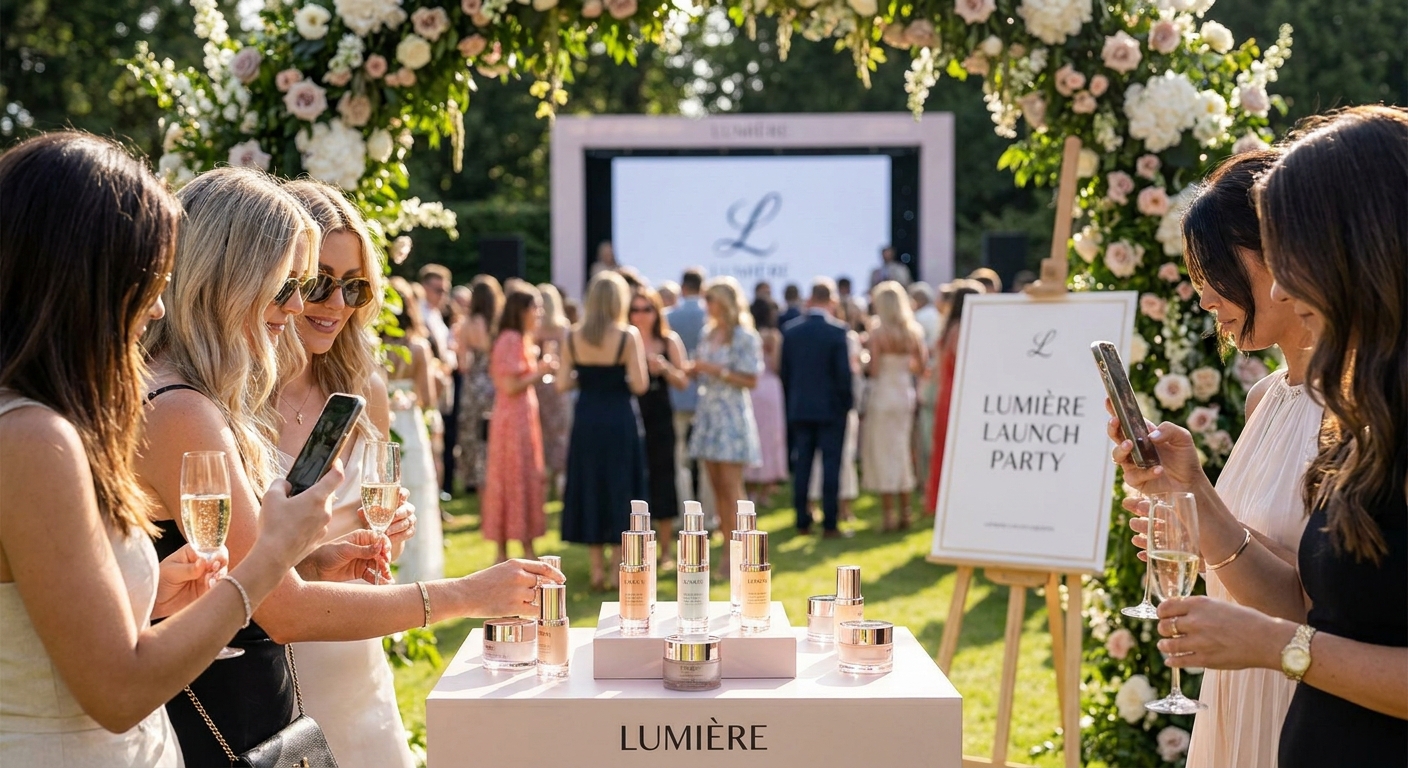
A large-scale party with 10+ major influencers and 150-300 guests generates a fast spike in impressions but a much lower ratio of genuine coverage to spend, since most attendees are there for the free product and not the brand story. It works when the brand already has category recognition and just needs a volume moment. Verdict: Skip for early-stage or unfunded launches; Buy only for brands with an existing following and a real ad budget behind the moment.
“If the guest list is chosen for headcount instead of reach, the event marketing budget bought a party, not a launch.”
What to avoid
- Oversized guest lists that dilute intimacy. A 200-person room with no structure produces less usable content than a 40-person dinner with a scripted moment.
- Any event without a live follow-up flow. If the email or SMS sequence isn't built and scheduled before the invites go out, the 48-hour window closes before anyone remembers to send it.
- Venues picked for aesthetics over brand fit. A gorgeous space that photographs beautifully but doesn't match the brand's price point or positioning confuses press and undercuts the story you're trying to tell.
Plan the launch before the venue
Get the strategy, guest list, and follow-up flow mapped before you book anything.
Verdict comparison table
| Format | Guest count | Cost tier | Best for | Verdict |
|---|---|---|---|---|
| Press-and-influencer dinner | 30-50 | Mid | Any funded launch | Buy |
| Multi-day pop-up | Rolling foot traffic | Mid-High | Retail-adjacent brands | Consider |
| Founder-led dinner series | 12-15 per dinner | Mid | Prestige, founder-story brands | Consider |
| Virtual/livestream launch | Unlimited | Low | Mass or masstige reach | Skip for prestige |
| Mega influencer party | 150-300 | High | Brands with existing following | Skip early-stage |
FAQ
What's the best event marketing for beauty brand launches on a limited budget?
A press-and-influencer preview dinner capped at 30-50 guests is the strongest return on a limited budget in 2026 because it produces earned coverage without the overhead of a large venue. A livestream launch is the cheaper fallback but trades intimacy for reach.
How many people should attend a beauty brand launch event?
30 to 50 press and influencer guests is the range that maximizes earned coverage per dollar. Anything past 100 guests shifts the math toward volume impressions instead of genuine advocacy.
Is a pop-up better than a single-night launch event for a beauty brand?
A multi-day pop-up of 3-5 days generates more usable content and repeat foot traffic than a single-night event, making it the stronger choice for retail-adjacent DTC brands. A single-night dinner still wins for press-heavy prestige launches.
How soon should follow-up emails go out after a beauty launch event?
Within 48 hours of the event, while intent is still fresh. Waiting past that window measurably reduces conversion because attendees forget product details fast.
Do virtual beauty launch events work as well as in-person ones?
Virtual launches scale to a larger audience at lower cost but underperform in-person events on earned press coverage, which matters most for prestige positioning. They work better for mass and masstige brands prioritizing reach over tactility.
What should be measured after a beauty brand launch event?
Track a unique promo code redemption rate, landing page conversions via UTM tagging, and 30-day sell-through against a control SKU. Attendance count and social impressions don't answer whether the event moved product.
How much should a beauty brand budget for a launch event?
Budgets for a press-and-influencer dinner in 2026 typically run $15,000 to $150,000 depending on market and guest list size. Multi-day pop-ups and mega influencer parties sit at the higher end of that range.
Should the founder attend the beauty brand launch event?
Yes, especially for prestige and indie brands where the founder story is the core brand narrative. A founder-led dinner series format is built specifically around that presence to deepen loyalty among top guests.
One last thing
The brands that get the most mileage out of a launch event in 2026 don't treat the night as the finish line — they treat it as the raw footage for the next quarter of content. A 30-guest dinner shot properly can outproduce a 90-day content calendar; a 300-guest party with no shot list produces almost nothing usable past the following Monday.