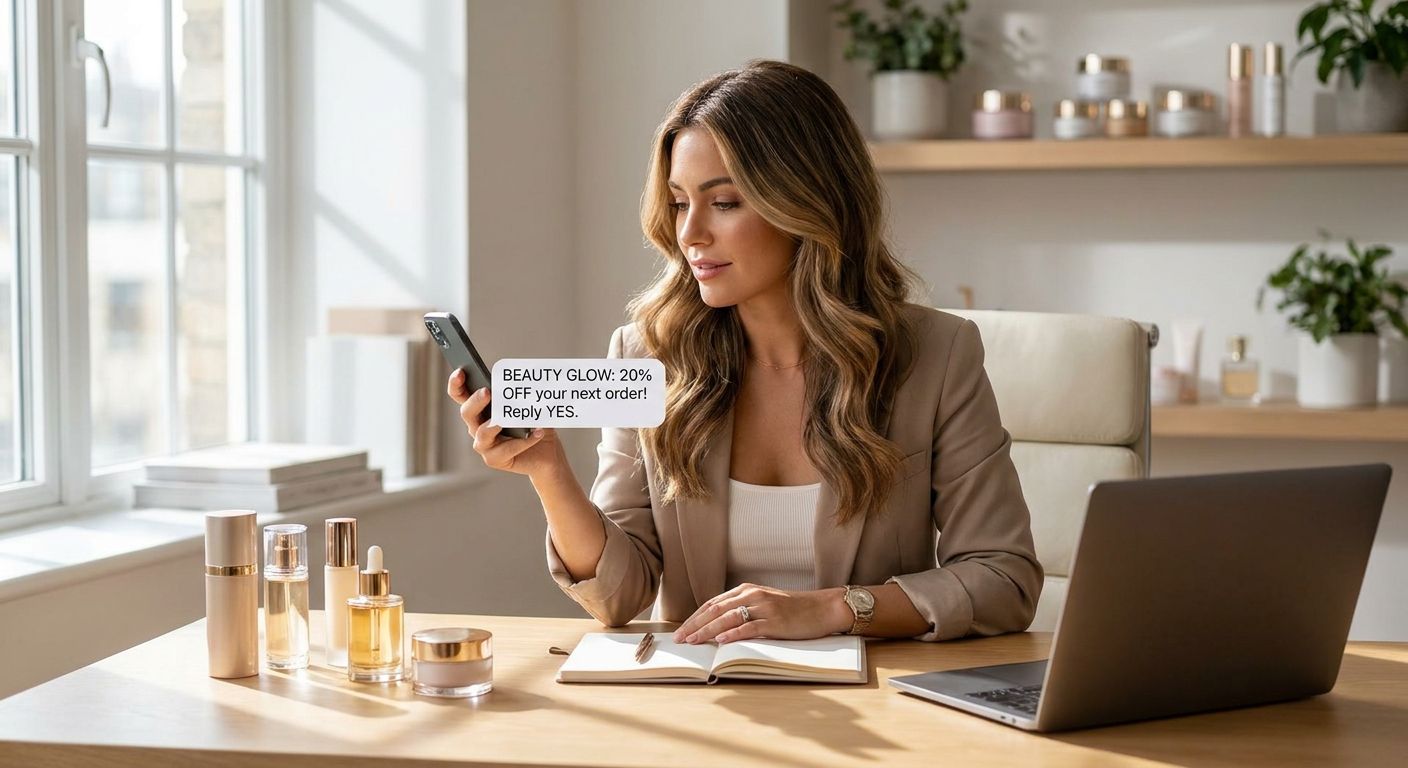
Building an SMS marketing strategy for a beauty brand in 2026 means combining a compliant opt-in system, a segmented flow architecture, and a send cadence that doesn't torch your subscriber list in month two.
- A compliant sms marketing strategy for a beauty brand starts with 10DLC registration and TCPA quiet hours (8am-9pm recipient time) — non-negotiable in 2026.
- Welcome, abandoned cart, post-purchase, and restock flows carry the highest revenue-per-send for beauty brands — build those four first.
- Cap promotional sends at 2-4 per week; more than that and opt-out rates climb fast in the beauty category.
- Segment by purchase behavior (first-time vs. repeat, product category, skin type where collected) before you segment by anything else.
Why this matters
Email open rates for beauty brands have been sliding for years as inboxes get more crowded. SMS still gets read — usually within minutes of landing on a lock screen — which is why it's become the highest-leverage retention channel for consumer and beauty brands scaling past their first few million in revenue.
But beauty subscribers are also fast to opt out the moment a brand oversends or gets generic. A skincare list that gets blasted with the same "20% off everything" text three times a week will churn its list faster than it grows it. The brands winning at SMS in 2026 treat it like a lifecycle channel, not a coupon-blaster.
The Darl builds SMS as one piece of a full omnichannel growth strategy — paired with email, paid social, and content so every channel reinforces the next instead of competing for the same discount-driven attention.
What you'll need
- An SMS platform that supports 10DLC or short-code registration (Attentive, Postscript, or Klaviyo SMS are the common picks for beauty brands in 2026)
- A compliant opt-in mechanism: checkout checkbox, pop-up with clear consent language, or keyword-to-join flow
- A segmented customer list — at minimum, first-time buyers vs. repeat buyers, and ideally product category or skin concern if you collect it at checkout or via quiz
- Creative assets sized for mobile: short copy, one link, optional MMS image
- 2-3 weeks of runway before launch to handle carrier registration and flow-building
- Alignment with your email calendar so SMS and email don't fire the same offer on the same day
The steps
1. Register your 10DLC campaign before you send anything
Carriers throttle or block unregistered traffic in 2026, and unregistered sends risk both deliverability and TCPA exposure. Registration through your SMS platform typically takes several business days to clear, so start this before you build a single flow. Skipping this step is the single most common reason a beauty brand's SMS program stalls in week one with messages stuck "pending."
2. Build your opt-in flow with a real incentive, not a vague one
A checkout checkbox alone won't grow a meaningful list — pair it with a pop-up offering a specific incentive (a discount code, early access to a launch, a free gift threshold) tied to opting in. Keep the consent language visible, not buried in fine print; the FTC and TCPA both care about clear disclosure, and vague consent language is what gets brands sued. Verdict: build the pop-up before you build a single promotional flow — list growth is the ceiling on everything else.
3. Set up your welcome flow to fire within 24 hours
The welcome text is the highest-engagement send in the entire program because the subscriber just took an action and is still paying attention. Trigger it immediately after opt-in confirmation, not after first purchase, and keep it to 2-3 messages spaced a day apart: a thank-you-and-offer text, then a product education text, then a soft nudge if no purchase yet. Common mistake: agencies bolt the welcome flow onto the same trigger as the email welcome series and end up sending both channels the identical offer on the identical day — space them by at least 24 hours.
4. Layer in abandoned cart and browse abandonment
SMS abandoned cart messages convert well in beauty because the AOV is usually low enough that a text feels proportionate to the purchase decision. Set the first text to fire 1 hour after cart abandonment, with a second follow-up at 24 hours if the cart is still open. Keep it to two messages — a third abandoned cart text is where opt-out rates spike.
5. Build a restock and back-in-stock flow
Beauty brands with hero SKUs that sell out benefit disproportionately from this flow because it converts high-intent buyers who already tried to purchase. Trigger the text the moment inventory syncs back to available, and keep the copy to one line plus a direct link — no need to sell the product again, the subscriber already wanted it.
6. Segment your promotional calendar by purchase history
Don't send the same discount code to a customer who bought seven days ago and one who bought seven months ago. Split your list into recent purchasers (excluded from most promo sends), lapsed customers (targeted with win-back offers), and never-purchased subscribers (targeted with lower-friction, first-purchase incentives). This is the segmentation step most beauty brands skip, and it's the one that protects your list from fatigue.
7. Cap send frequency and monitor opt-out rate weekly
Hold promotional SMS to 2-4 sends per week outside of major launch or sale windows, and check your opt-out rate after every send — a spike above your program's baseline is the earliest warning sign of list fatigue. If you're running SMS alongside a paid media funnel for your beauty brand, coordinate frequency so a subscriber isn't hit by a retargeting ad and a promo text in the same hour.
8. Connect SMS to your lifecycle and subscription flows
If you run a subscription or replenishment model, SMS is where renewal reminders and "time to reorder" nudges outperform email on speed. Building this connective layer is where lifecycle marketing for beauty subscription brands becomes the difference between a program that just announces sales and one that actively extends customer lifetime value.
Get an SMS program built for beauty
See how omnichannel strategy ties SMS, email, and paid together.
Troubleshooting
- Messages showing as "pending" or not delivering: your 10DLC registration hasn't cleared yet, or your campaign was flagged for unclear opt-in language — check your platform's compliance dashboard first.
- Opt-out rate climbing above baseline: you're sending too frequently or repeating the same offer email already sent that day — pull back to 2 sends per week and re-check your email/SMS calendar overlap.
- Low click-through on promotional texts: the offer or copy is too generic — beauty subscribers respond to specificity (a named product, a real discount amount, a countdown) far more than "shop now" language.
- Welcome flow converting but no repeat purchase: the flow stops too early — add a post-purchase education text and tie it into your broader email marketing for DTC beauty brands sequence so the subscriber doesn't go quiet after order one.
- List growth stalling under 1% of site traffic opting in: your incentive is too weak or the pop-up timing is off — test earlier triggers (on-page-load or exit-intent) against your current delay.
- Legal/compliance concern after a customer complaint: stop sends to that segment immediately, review your consent records, and confirm your quiet-hours settings match 8am-9pm in the recipient's time zone, not your own.
Tools and resources
- An SMS platform with 10DLC support (Attentive, Postscript, Klaviyo SMS)
- A synced email calendar to prevent channel overlap
- Segmentation data pulled from your ecommerce platform or quiz tool
- A compliance checklist covering opt-in language, quiet hours, and unsubscribe handling
- If you're building the surrounding funnel at the same time, review the paid media funnel guide so SMS isn't running in isolation from acquisition spend
What to do next
Once the core flows are live, the next move is auditing whether your agency partner (or internal team) is running SMS as a standalone channel or as part of a connected system. If you're evaluating who should build this out, how to choose a marketing agency for your beauty brand covers what to ask before signing a retainer in 2026.
FAQ
What's the best SMS platform for a beauty brand in 2026?
Attentive, Postscript, and Klaviyo SMS are the three most common picks for beauty brands in 2026, chosen based on whether you're already on Klaviyo for email and how much segmentation depth you need. The right pick depends more on your existing tech stack than any single feature.
Is SMS marketing better than email for beauty brands?
SMS and email serve different roles rather than competing — SMS gets read faster but tolerates far less frequency, while email carries more content and visual product detail. A beauty brand's sms marketing strategy should run alongside email, not replace it.
How much does SMS marketing cost for a beauty brand?
Cost depends on platform pricing tiers, list size, and message volume, since most SMS platforms charge per message sent plus a subscription fee. Get a quote directly from the platform based on your current list size and expected send frequency.
How many SMS messages per week is too many for a beauty brand?
More than 2-4 promotional texts per week typically pushes opt-out rates up in the beauty category, though flow-triggered texts (welcome, cart, restock) don't count against that cap since they're behavior-triggered, not blast sends.
Do I need a lawyer to launch SMS marketing legally?
You don't need a lawyer to launch, but you do need compliant opt-in language, documented consent, and quiet-hours enforcement (8am-9pm recipient time) to avoid TCPA exposure, which carries fines of $500 to $1,500 per violating message.
What's the first SMS flow a beauty brand should build?
The welcome flow, triggered within 24 hours of opt-in, converts highest because the subscriber just took an action and is still engaged. Abandoned cart and restock flows should follow immediately after.
Can SMS and email use the same offer on the same day?
Avoid it — sending the identical discount through both channels on the same day trains subscribers to ignore whichever channel arrives second. Stagger offers by at least 24 hours or split the offer between segments.
Does SMS work for indie beauty brands with small lists?
Yes, SMS works at small list sizes because the flows (welcome, cart, restock) are behavior-triggered rather than volume-dependent, so a brand with a few hundred subscribers still sees engagement from a well-built welcome sequence.
One last thing
The beauty brands getting the most out of SMS in 2026 aren't the ones sending the most texts — they're the ones who cut their promotional cadence and let behavior-triggered flows (welcome, cart, restock) carry the revenue instead. That shift alone is usually what separates a program with a healthy opt-out rate from one bleeding subscribers every month.