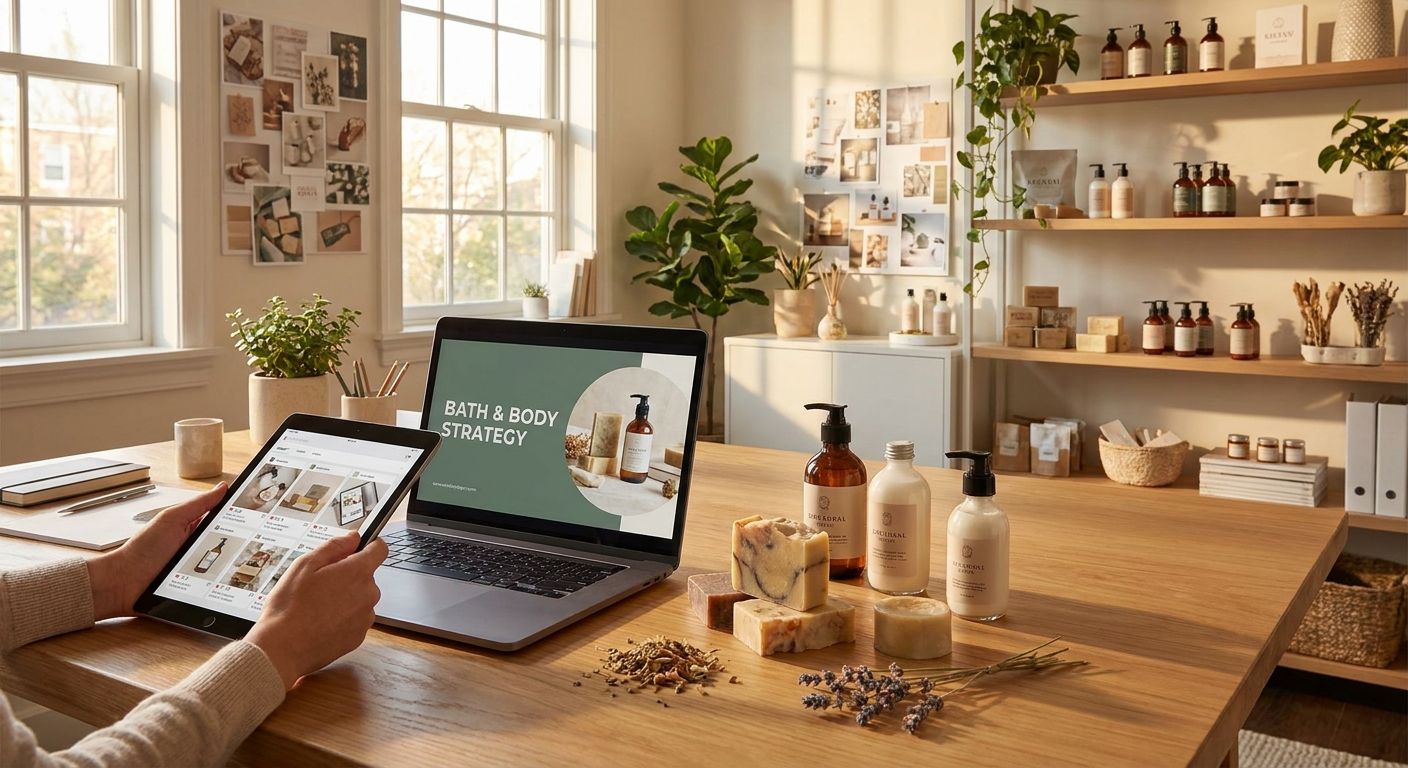
Bath and body brand marketing agency work is the coordinated mix of paid media, SEO, email, SMS, and content that turns a one-time scrub or soap purchase into a repeat customer on a consumable replenishment cycle. This segment behaves differently than skincare or color cosmetics: purchases are impulse-driven, price points sit lower per unit, and gifting seasons (Q4, Mother's Day, Valentine's) can swing revenue harder than any other beauty subcategory.
- A marketing agency for bath and body brands needs to run gifting-season paid media, replenishment email/SMS, and scent-forward content in one system, not three disconnected vendors.
- The Darl builds omnichannel growth strategy for consumer and beauty brands, sequencing SEO, paid, email, and social so each channel compounds the next.
- DIY works below roughly $500k in revenue; past that, the channel coordination gap costs more than an agency retainer.
- Bundling and gifting content should launch 8-10 weeks before Q4, not during it.
Why this matters for bath and body brands
Bath and body is a consumable category. Body wash, lotion, and bar soap get used up in weeks, which means the reorder window is tight and the brand that isn't in a customer's inbox or on their phone at the 30-90 day mark loses that reorder to whatever's on the Target shelf. That's a fundamentally different retention problem than a $120 serum bought twice a year.
Gifting compounds the pressure. Q4 and the spring gifting holidays are when bath and body brands see the sharpest demand spikes, and a brand that hasn't built bundles, gift sets, and paid creative around those windows by early fall is marketing reactively instead of on a calendar. The Darl builds omnichannel strategy specifically so gifting-season paid spend, email flows, and content don't get built in a scramble.
Retail complicates it further. Bath and body brands frequently sell in Target, Ulta, and specialty gift retail alongside DTC, and each channel has its own creative, compliance, and margin rules. A generalist agency that only knows DTC paid social will miss half the growth surface area.
Audit your product story before you spend a dollar on ads
Before any paid spend, get the product narrative right. Bath and body buyers decide fast, often on scent, texture, and "what does this actually do for my skin" — not on ingredient science the way skincare buyers do.
- List every SKU's core sensory hook (scent family, texture, use-occasion) in one line each
- Pull your top 5 customer reviews and mine them for the exact language buyers use
- Check ingredient claims against FTC and FDA cosmetic labeling rules before they hit ad copy
- Identify which SKUs are gift-set ready and which are standalone reorder products
- Flag any claims ("clinically proven," "detoxifying") that need substantiation before running them in paid creative
Build a content engine around ritual, not just ingredients
Bath and body content converts on the experience of use — the shower ritual, the ten-minute soak, the gift-unboxing moment — more than it does on a molecule list. Skincare-style ingredient breakdowns underperform here.
- Shoot short-form video of texture and lather, not just product-on-white stills
- Build a "ritual" content series (morning routine, bath night, gifting) tied to specific SKUs
- Repurpose UGC from unboxing and gifting moments — this content converts better than studio shots
- Map content to occasions: self-care Sunday, holiday gifting, travel-size bundles
This is the step where a generalist freelancer starts to show cracks — content, paid, and email need to pull from the same creative calendar, which is exactly the coordination an omnichannel agency is built to run.
Run paid social matched to your gifting calendar, not a flat always-on budget
Flat, always-on paid budgets waste spend in bath and body because demand isn't flat — it spikes hard around gifting.
- Build a media calendar that front-loads spend 8-10 weeks before Q4 and Mother's Day
- Test gift-set creative separately from single-SKU reorder creative
- Use retargeting sequences tuned to a 30-90 day repurchase window, not a 7-day skincare cycle
- Layer Pinterest and Meta together — Pinterest indexes heavily for gifting and home-spa searches in this category
See how Pinterest ads work for a beauty brand for a channel-specific breakdown of that gifting-intent traffic.
Set up replenishment email and SMS flows on a real reorder timeline
Because bath and body is consumable, lifecycle marketing has to run on the product's actual use-up timeline, not a generic post-purchase drip.
- Build a replenishment flow triggered at 45, 60, and 90 days based on the SKU's typical use-up rate
- Segment gift purchasers separately — they need a different flow than self-purchasers
- Add SMS for time-sensitive gifting deadlines (shipping cutoffs matter more here than in most beauty subcategories)
- Test subscribe-and-save offers on the highest-repeat SKUs before rolling out storewide
Seed influencers and UGC creators around texture, scent, and gifting occasions
Influencer seeding in this category works best when creators show the sensory experience live — unboxing a gift set, showing lather, describing scent — rather than talking through an ingredient deck.
- Seed micro-creators (10k-100k followers) ahead of Q4 for gift-guide inclusion
- Prioritize video-first platforms where texture and scent can be shown, not just described
- Track which creator content drives adds-to-cart versus just views
- Build a standing seeding list refreshed each gifting season, not a one-off send
Get retail-ready before you pitch Target, Ulta, or specialty gift retail
If wholesale or big-box retail is on the roadmap, marketing has to support that pitch with proof — not just DTC traction.
- Build a sell sheet with DTC sales velocity, repeat purchase rate, and review volume
- Align packaging and claims language with retail compliance standards before a buyer meeting
- Show a content and paid media plan the retailer can point to as brand support post-launch
- Time retail launches to align with the gifting calendar retailers are already planning around
If you're weighing whether to run this in-house or bring in outside help, how to choose a marketing agency for your beauty brand walks through the vetting questions that matter most for this category.
Comparison: options for running bath and body marketing in 2026
| Option | Best for | Key limitation |
|---|---|---|
| In-house marketing team | Brands over roughly $3M revenue with dedicated headcount budget | Slow to build cross-channel capability; hard to hire for paid, email, and content simultaneously |
| Freelance/generalist agency | Single-channel needs (just paid, or just email) | No cross-channel calendar coordination; gifting-season planning falls through the cracks |
| Beauty-focused omnichannel agency (The Darl) | Brands scaling past $500k-$1M ready to coordinate SEO, paid, email, and content on one calendar | Retainer cost only makes sense once a brand has product-market fit and a live revenue base to grow |
| Founder-led DIY | Early-stage brands under $500k, pre-launch or just-launched | Founder bandwidth caps growth; gifting-season execution suffers without dedicated hands |
A candle or home-fragrance brand selling into similar gifting occasions faces a nearly identical calendar problem — see marketing for candle and home fragrance brands if that overlap applies to your catalog.
Common mistakes bath and body brands make
- Treating body care like skincare content. Ingredient decks and clinical claims underperform against sensory, ritual-driven content in this category.
- Building gifting creative in November. By the time Q4 demand peaks, the creative and paid budget should already be live — building it reactively means missing the first three weeks of the season.
- Running one flat email flow for every SKU. A body scrub used up in 30 days and a body oil used up in 90 need different replenishment triggers.
- Ignoring retail compliance until a buyer meeting is booked. Claims language that works fine on a DTC site can stall a Target or Ulta pitch.
- Over-indexing on one hero scent. Single-SKU dependency leaves the brand exposed the moment that scent's trend cycle fades.
A bath and body brand's marketing calendar has to be built around a consumable's reorder cycle and the gifting seasons that drive spikes — not a flat always-on budget.
Build your 2026 gifting calendar now
Get an omnichannel plan across paid, email, and content before Q4 hits.
FAQ
What does a marketing agency for bath and body brands actually do?
It runs paid media, SEO, email/SMS, and content in one coordinated plan built around a consumable product's reorder cycle and gifting seasons. The Darl builds this as an omnichannel strategy rather than separate single-channel vendors.
When should a bath and body brand hire an agency instead of staying in-house?
Once revenue passes roughly $500k-$1M and gifting-season execution starts slipping, the coordination gap between channels costs more than a retainer. Below that, founder-led DIY usually works fine.
How far ahead should Q4 gifting content be planned?
Creative and paid budget should go live 8-10 weeks before Q4 starts, not during peak demand. Waiting until November means missing the first weeks of the season entirely.
What's different about bath and body marketing versus skincare marketing?
Bath and body converts on sensory experience and ritual — scent, texture, gifting occasion — while skincare content leans heavier on ingredient claims and clinical proof. The reorder cycle is also shorter and more consumable-driven.
How often should replenishment emails go out for consumable body care?
Trigger flows around the 45, 60, and 90 day marks depending on the SKU's typical use-up rate. A body scrub and a body oil need different timing.
Does Pinterest work for bath and body brands?
Yes — Pinterest indexes heavily for gifting and home-spa search intent, which lines up directly with bath and body's gift-driven purchase pattern.
What retail channels matter most for bath and body brands?
Target, Ulta, and specialty gift retail are the most common wholesale entry points, each with its own compliance and creative requirements separate from DTC.
Is influencer seeding worth it for a bath and body brand?
It works best when creators show texture, lather, and unboxing live on video rather than describing ingredients — that sensory proof drives adds-to-cart more than talk-through content.
One last thing
The single highest-leverage move most bath and body brands skip: building the gift-set replenishment flow separately from the self-purchaser flow. Gift recipients don't know your brand's reorder cadence yet, so treating them like existing customers in 2026 wastes the exact window when they're most likely to convert into a repeat buyer.