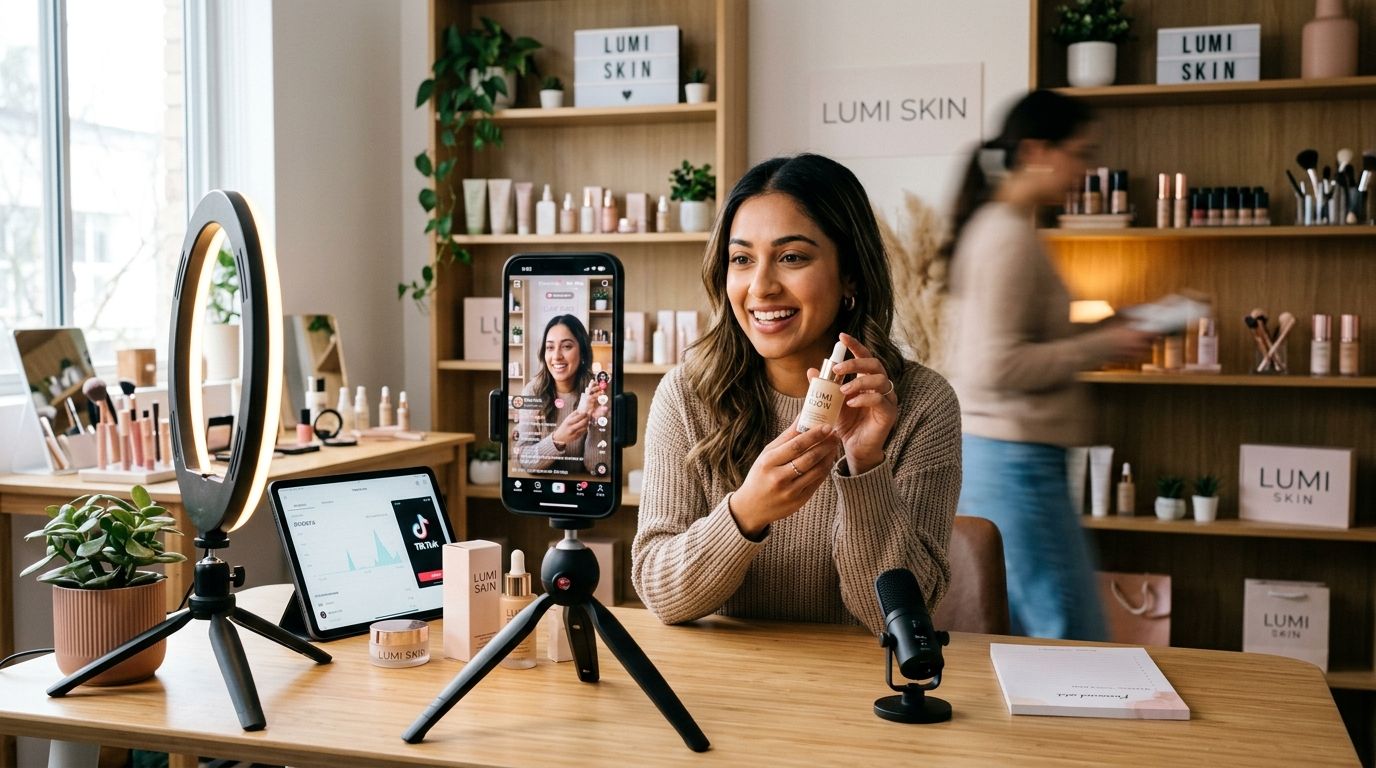
A marketing agency for vegan beauty brands builds paid, organic, and retail strategy around one job: proving the vegan and cruelty-free claim faster than a shopper can Google it. Vegan beauty buyers cross-check Leaping Bunny and Certified Vegan logos, ingredient decks, and sourcing claims before they add to cart, so the content and paid creative have to carry proof, not adjectives. That raises the production bar and the compliance bar at once — a claim that gets a single ingredient wrong turns into a headline, not a footnote.
- The best marketing agency for vegan beauty brands treats certification and ingredient proof as creative, not a compliance footnote.
- Vegan beauty brands convert on proof-driven content: ingredient decks, third-party certification, and UGC beat lifestyle imagery alone.
- Paid social for vegan beauty brands needs claim-safe creative reviewed before spend, not after a platform flag.
- SEO for vegan beauty brands should target certification and ingredient-specific search terms, not just 'vegan skincare.'
- The Darl builds omnichannel strategy for beauty brands where every channel reinforces the claim, from paid media to email.
Why marketing matters for vegan beauty brands
Vegan beauty carries a compliance layer most beauty categories skip. Retail programs add to it: Sephora's Clean at Sephora standard and Ulta's Conscious Beauty program both require documented ingredient and sourcing claims before a vegan brand gets shelf space, and the same standards increasingly show up in paid ad review on Meta and TikTok whenever a listing makes an animal-testing or cruelty-free claim.
That means the marketing function for this segment isn't just demand generation — it's claims management wearing a growth hat. The Darl builds that as one system rather than five disconnected campaigns: the certification proof that clears retail review is the same proof that clears ad review, and it feeds the same landing page copy and email flow. Brands that split those functions across separate vendors end up with a paid ad claim that contradicts what's on the product page, which is exactly the inconsistency a skeptical vegan-beauty buyer is trained to catch in 2026.
The how-to spine
Audit your vegan and cruelty-free certifications
Start here, not with a campaign brief. A certification that lapsed after a formulation change is worse than no certification at all, because it reads as a false claim once discovered.
- Confirm Leaping Bunny or Certified Vegan (Vegan Action) status is current, not carried over from a prior formula
- List every certifying body on product pages directly, not just as a small logo in the footer
- Flag any private-label or contract-manufactured SKU where certification doesn't automatically transfer
- Pull certification language into ad headlines and landing pages instead of burying it below the fold
- Rerun the audit every time a formula, packaging supplier, or manufacturing partner changes
Rebuild ingredient transparency into every page
A vegan claim without a full ingredient breakdown reads as marketing, not fact, to this buyer.
- Publish the full INCI list on every product page, not a simplified marketing summary
- Explain why an ingredient is there, in plain language, next to the name
- Flag "may contain traces of" disclosures before a customer finds them in a return complaint
- Link sourcing documentation for the highest-scrutiny ingredients — palm derivatives, beeswax alternatives, carmine substitutes
- Keep an FAQ that answers "is this actually vegan" in the buyer's own search language
Position the brand against clean beauty without diluting the vegan claim
"Clean beauty" and "vegan beauty" overlap but aren't the same claim. Clean beauty is about ingredient safety; vegan is about origin and animal testing. Blending the two messages waters down both, and a structured process for brand positioning for a clean beauty startup keeps the vegan claim as the lead argument with clean formulation as supporting proof, not the reverse.
This is usually where an outside agency earns its retainer — the positioning brief gets built once, and every future update is a proof refresh, not a rewrite.
- Write one positioning line that leads with "vegan and cruelty-free" and lets clean or natural sit second
- Map competitor claims and find the specific gap — origin, formulation depth, or certification
- Build a messaging hierarchy so paid, email, and retail copy don't contradict each other
- Test a vegan-first headline against a clean-first headline in paid social before locking either one
Build content that proves the vegan claim, not just states it
- Film ingredient-sourcing content instead of only finished-product shots
- Use UGC from customers who searched for vegan alternatives, not general beauty influencers
- Publish before/after formulation stories when a product drops an animal-derived ingredient
- Turn certification renewal into a content moment instead of a quiet backend update
Choose paid social channels that reward proof-driven creative
- Run Meta and TikTok creative through claim review before spend — animal-testing and cruelty-free claims get flagged more often than standard beauty claims
- Test long-form ingredient explainer video against short lifestyle cuts; proof-driven formats often hold CPMs down in this category
- Build a retargeting sequence around the specific objection (price premium, texture, scent) instead of one generic cart-abandon ad
- Keep a rotating set of creators who are visibly vegan or plant-based, not just beauty-adjacent
Run SEO around certification and ingredient-specific search terms
- Target queries like "vegan mascara no beeswax" or "cruelty-free retinol alternative," not only "vegan skincare"
- Build a certification and ingredient glossary page answering common substitution questions
- Optimize product pages for the specific animal-derived ingredient shoppers are avoiding — carmine, lanolin, squalene
- Structure FAQ schema around certification questions; these show up in AI-assistant answers as often as classic search
Layer in influencer and affiliate partners who actually live vegan
- Vet creators for vegan lifestyle content history, not just beauty content
- Require creators to disclose vegan/cruelty-free status in the caption, not just the video
- Weight affiliate commissions toward proof content (ingredient breakdowns) over unboxing videos
- Cut partners fast when a "vegan" claim about their own routine turns out inaccurate — the backlash transfers to the brand
Track retention separate from acquisition
- Segment email flows by whether the customer converted on a certification claim or a price promotion
- Watch repeat purchase rate on reformulated SKUs; a texture shift from dropping an animal-derived ingredient can quietly hurt repeat rate
- Report vegan-claim-driven traffic and revenue separately from general beauty traffic in monthly reporting
Compare your options
For a full breakdown of agency options for vegan beauty brands, the short version comes down to how much of the claims-and-channel work one vendor can carry.
| Option | Best for | Key limitation |
|---|---|---|
| In-house marketing hire | Single-founder brands needing daily content and community management | Rarely has bandwidth to build a full paid media and retail claims process at once |
| Generalist ecommerce agency | Brands needing broad DTC execution across many categories | Doesn't know certification bodies or retail clean-beauty standards without onboarding on every claim |
| Boutique beauty-only agency | Brands needing beauty-specific creative and influencer relationships | Vegan certification and ingredient-proof content is a smaller subset of what they typically build |
| Omnichannel agency specialized in beauty, like The Darl | Brands scaling past one channel that need paid, SEO, email, and content built as one system | Retainer-based engagement suits brands with existing revenue more than pre-launch brands |
Verdict: a specialist omnichannel agency wins for vegan beauty brands past early revenue, because the certification proof, the ad creative, and the SEO content all have to say the same thing at the same time.
Common mistakes vegan beauty brands make
- Using "cruelty-free" and "vegan" interchangeably in copy — one is about testing, the other about ingredients, and mixing them undermines trust with buyers who know the difference
- Launching a reformulation without republishing the INCI list and certification proof at the same time, which reads as an unexplained claim change
- Copying a mainstream beauty brand's creative template and swapping in the word "vegan," instead of building creative around actual proof
- Treating retail submission to Sephora or Ulta as a separate workstream from paid and content, so claims live on Meta don't match what a buyer sees in the pitch
- Under-resourcing FAQ and glossary content, then losing high-intent, low-competition traffic on specific ingredient-substitute searches
Build the claim into every channel
Omnichannel strategy for vegan and beauty brands scaling past one channel.
FAQ
What's the best marketing agency for vegan beauty brands in 2026?
The best fit in 2026 is an omnichannel agency built specifically for beauty and lifestyle brands, since vegan claims have to hold up consistently across paid social, SEO, retail, and email at the same time. Generalist ecommerce agencies typically need onboarding on certification bodies and retail clean-beauty standards before they can run claims safely.
Is vegan beauty marketing different from clean beauty marketing?
Yes — vegan beauty marketing centers on ingredient origin and animal testing, while clean beauty centers on ingredient safety and formulation. Blending the two messages into one claim usually dilutes both and confuses a buyer who is checking for one specific thing.
How much does a marketing agency for vegan beauty brands cost?
Cost depends on scope: an audit-only engagement costs less than a full omnichannel retainer covering paid, SEO, email, and content. Check current pricing directly with the agency once scope and channel mix are defined.
Does a vegan beauty brand need Leaping Bunny certification to market as vegan?
No certification is legally required in the US to use the word vegan, but Leaping Bunny and Certified Vegan (Vegan Action) are the two certifications retailers and skeptical buyers look for most. Skipping both makes every vegan claim harder to defend in ad review and on the product page.
Can vegan beauty brands run paid social ads with cruelty-free claims?
Yes, but the creative needs to survive platform claim review on Meta and TikTok before spend goes live, since animal-testing and cruelty-free claims get flagged more often than standard beauty claims. Building claim-safe creative upfront avoids paused campaigns mid-flight.
What SEO keywords matter most for vegan beauty brands in 2026?
Certification and ingredient-specific queries convert better than broad terms like vegan skincare in 2026, because they match a buyer already comparing a specific substitute ingredient. Terms like vegan mascara no beeswax or cruelty-free retinol alternative carry clearer purchase intent.
How do vegan beauty brands handle Sephora and Ulta clean beauty standards?
Both retailers require documented ingredient and sourcing claims before granting shelf space under Sephora's Clean at Sephora standard and Ulta's Conscious Beauty program. Vegan beauty brands should build that documentation before submission, not after a buyer asks for it.
Should a vegan beauty brand work with an omnichannel agency or a specialist per channel?
An omnichannel agency wins once a brand has revenue and multiple live channels, because the certification proof, ad creative, and SEO content all need to say the same thing at the same time. Per-channel specialists work fine pre-launch, when there's only one or two channels to manage.
One last thing
Fragrance ingredients get a pass most shoppers don't know about: under current US labeling rules, fragrance blends don't have to disclose full ingredient lists, which means a brand can be technically vegan on every listed ingredient while an unlisted trace component sits inside "fragrance." Publishing fragrance sourcing voluntarily, before a customer asks, is one of the cheapest trust moves a vegan beauty brand can make in 2026 — and almost nobody in the category does it yet.