Fragrance sells on a sense you can't put in a photo — a content strategy for a fragrance brand has to translate scent into story, texture, and ritual well enough that someone buys a bottle they've never smelled. This guide walks through the exact build, step by step, for 2026.
- Building a content strategy for a fragrance brand starts with a scent-to-story map, not a posting calendar.
- Video carries scent description better than static product shots — prioritize it before paid spend.
- UGC and influencer seeding close the sensory gap e-commerce can't close alone; seed before you launch, not after.
- Email content should sell the ritual of wearing the fragrance, not just the launch date or discount.
- Generic "top notes" copy reads like a spec sheet and converts like one — skip it.
Why this matters
A fragrance is the only beauty category where the product itself is invisible online. Skincare shows texture, makeup shows pigment on skin — fragrance shows a bottle and asks the buyer to imagine a smell from a paragraph of adjectives.
That's why most fragrance brand content underperforms: it describes notes instead of building a world. Content marketing for indie beauty brands that wins in 2026 treats the content system as the product demo, not the decoration around it.
The brands scaling past their first six-figure launch year aren't the ones with the best liquid — they're the ones with a content system that makes strangers feel the scent before they buy it.
What you'll need
- A note breakdown for every SKU (top, heart, base) written in plain language, not perfumer jargon
- A founder or brand voice on camera — fragrance content performs better with a face and a point of view attached
- 3-5 seeded creators or micro-influencers per launch, briefed before the drop, not after
- A content calendar tool that separates evergreen SEO content from launch-cycle content
- An email flow structure ready to carry ritual-based content, not just promotional blasts
- Budget reserved for paid amplification of the top 10-15% of organic content, not for producing more of it
The steps
1. Map your scent story before you map your content calendar
This step forces you to define what the fragrance means before you decide what to post about it. Skipping it is why so many fragrance content calendars are full of posts that describe the bottle instead of selling the feeling.
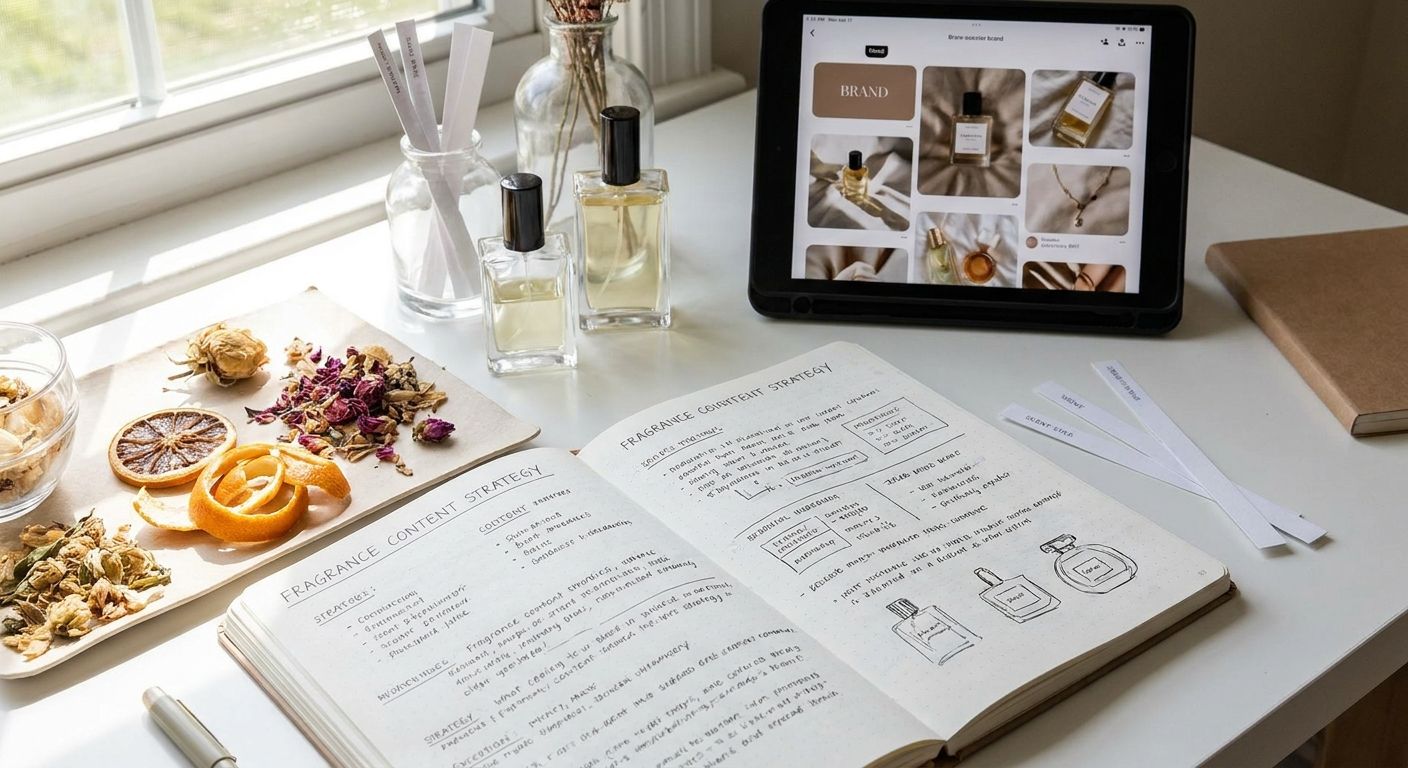
Write one paragraph per SKU: the memory or moment it's built around, the mood it shifts you into, and one sentence a customer could use to describe it to a friend. Expected outcome: every piece of content going forward — TikTok script, email subject line, product page copy — pulls from this document instead of getting reinvented each time. Common mistake: writing the story around the perfumer's brief instead of the customer's life.
2. Translate notes into narrative for every SKU
This turns your ingredient list into content that a non-perfumer actually wants to read or watch. Nobody outside the industry cares that a scent has "ambroxan" in the base — they care what it feels like at 9pm on a first date.
For each SKU, write three sentences: what it smells like in plain language, what situation it's built for, and what it smells like layered with a second product if you sell one. Post this as short-form video with the bottle in hand, not as a paragraph under a product photo. Expected outcome: product pages and captions stop reading identically across your catalog. Common mistake: reusing the same three adjectives ("warm," "cozy," "woody") across every SKU until none of them mean anything.
3. Prioritize video over static product photography
Video is the format that gets closest to simulating scent — tone of voice, texture of the room, reaction shots — and it's what carries a fragrance brand's content strategy in 2026 far more than a flat-lay ever will.
Build a monthly cadence of 8-12 short-form videos per launch cycle: unboxing, layering demos, "what this smells like" comparisons, and founder or team reaction content. Expected outcome: watch-through rate becomes your leading indicator, not likes. Common mistake: treating video as a repurposed still photo with music added instead of building it around motion and voice from the start.
4. Seed UGC and micro-influencers before you spend on paid
This step gets other people's noses to vouch for a scent your customer can't test themselves — social proof does the sensory work paid ads can't. Seeding early also gives you organic content to fuel paid later, instead of paying to produce it from scratch.
Send product to 15-30 creators 3-4 weeks before a launch date, briefed on the story from step 1, not a generic product description. Track which creators generate saves and shares, not just views, and fold their raw footage into your paid ad account. Expected outcome: a bank of authentic reaction content before day one of the public launch. Common mistake: seeding too late, so the first wave of content drops after the launch buzz has already faded.
5. Build an email content cadence around the ritual, not the launch
Fragrance repurchase runs on habit — someone reaches for the same bottle for two years — so email content has to sell the daily ritual of wearing it, not just the 20%-off flash sale. This is where most fragrance brands leave revenue on the table between launches.
Build a recurring monthly send around "how to wear it" content: layering combinations, seasonal application tips, and customer photos of the bottle in their space. Expected outcome: email becomes a retention channel, not just a launch-day blast. Common mistake: only emailing during drops and going quiet the other 10 months of the year.
6. Layer SEO content for discovery-stage search intent
Most fragrance discovery still starts with a search — "best fall fragrance," "[note] perfume for men," "long-lasting perfume under $100" — and content built for those queries captures demand your social feed never will. SEO for fragrance ecommerce brands is the layer that keeps working after a launch's social buzz dies down.
Build 4-6 evergreen guides per quarter around search intent, not brand-name keywords: comparison content, occasion-based guides, and "how long does X last" style posts. Expected outcome: organic search traffic that compounds instead of resetting to zero after every campaign. Common mistake: writing SEO content in brand voice instead of the plain language people actually search in.
7. Set a review cadence against sell-through, not likes
This step keeps the entire content strategy honest — a fragrance brand can rack up views on a video that never moves a single bottle. Reviewing against sell-through data instead of vanity metrics is what separates a content system from a content habit.
Review monthly: which content pieces correlate with spikes in add-to-cart and email click-through, and double down on that format next cycle. Expected outcome: a shrinking list of content types you keep making and a growing conversion rate per post. Common mistake: judging a video's success by views when the product never had inventory pressure to move.
“If your content doesn't sell the feeling before the formula, it won't sell the fragrance.”
Build the system, not just the calendar
Get an omnichannel content audit built for fragrance and beauty brands.
Troubleshooting
- Content gets views but sales don't move. Check whether the content is describing the product or the feeling — views without sell-through usually means the story from step 1 never made it into the script.
- UGC feels generic across creators. Brief creators on the specific scent story per SKU instead of a general product blurb; identical talking points across ten creators reads as scripted, not authentic.
- Email opens are fine but clicks are flat. The subject line is probably promotional while the body is educational, or vice versa — match the ritual-based content tone from subject line through to CTA.
- SEO content ranks but doesn't convert. The guide is probably answering the search query and stopping there, with no product tie-in or internal link back to the fragrance it's built to sell.
- Video watch-through drops in the first 3 seconds. The hook is leading with the brand name or bottle instead of the moment or feeling — reorder the script so the payoff comes first.
Tools and resources
- A shared note-to-narrative document, updated every time a new SKU launches
- A creator seeding tracker with launch-date lead time built in
- Email marketing for fragrance brands as a reference for building ritual-based flows instead of promo-only sends
- A monthly content review dashboard tied to add-to-cart and click-through, not impressions
- A shot list template covering unboxing, layering, and reaction-format video
What to do next
Once the content system is running, the next lever is scaling what's already converting — through paid amplification, creator budget, or a second SKU launch built on the same story framework. A fragrance brand's content strategy in 2026 isn't a one-time build; it's a system that gets reviewed and rebuilt every launch cycle.
FAQ
What's the best content strategy for a fragrance brand?
The best content strategy for a fragrance brand starts with a scent-to-story map for each SKU, then builds video, UGC, email, and SEO content around that story instead of generic note descriptions. Brands that skip the story step end up with content that describes the bottle instead of selling the feeling.
How is content marketing for fragrance brands different from skincare or makeup?
Fragrance content has to sell an invisible product, so it leans harder on story, mood, and video than skincare or makeup content, which can show texture and results directly. That gap is why fragrance brands depend more heavily on UGC and influencer seeding for social proof.
How much should a fragrance brand invest in content each month?
Investment varies by launch cadence, but a working system needs a monthly video shoot, a recurring creator seeding budget per launch, and an evergreen SEO content cadence of 4-6 pieces per quarter. Budget should shift toward amplifying top-performing organic content rather than producing more unproven content.
Is UGC or influencer seeding better for fragrance launches?
Both work together rather than as a choice — UGC builds volume and authenticity while seeded micro-influencers build reach and credibility for a specific launch. Seeding 15-30 creators 3-4 weeks before launch typically produces both outcomes at once.
How often should a fragrance brand post on TikTok and Instagram?
A working cadence runs 8-12 short-form videos per launch cycle, mixing unboxing, layering demos, and reaction content. Posting less than that leaves discovery-stage buyers without enough content to build trust before purchase.
Do fragrance brands need SEO content if most discovery happens on social?
Yes, because search captures buyers actively looking to purchase, while social captures buyers who are browsing. SEO content built around comparison and occasion-based queries keeps converting long after a launch's social buzz fades.
How long before a content strategy shows results for a fragrance brand?
Video and UGC content can show engagement signals within the first launch cycle, but SEO content and email retention content typically take one to two quarters to compound. Reviewing against sell-through monthly, not weekly, gives a more accurate read.
Should founders appear on camera for a fragrance brand?
Yes — founder-led video consistently outperforms faceless brand content for fragrance because it attaches a point of view to an otherwise invisible product. This matters most in the early growth stage before the brand has built its own recognizable identity.
One last thing
The fragrance brands still growing past their launch year in 2026 are the ones that stopped treating content as a launch-week activity and started treating it as year-round infrastructure — the note-to-narrative document from step 1 gets reused for years, not weeks. Build that document once and every future SKU launch gets faster and cheaper to support.