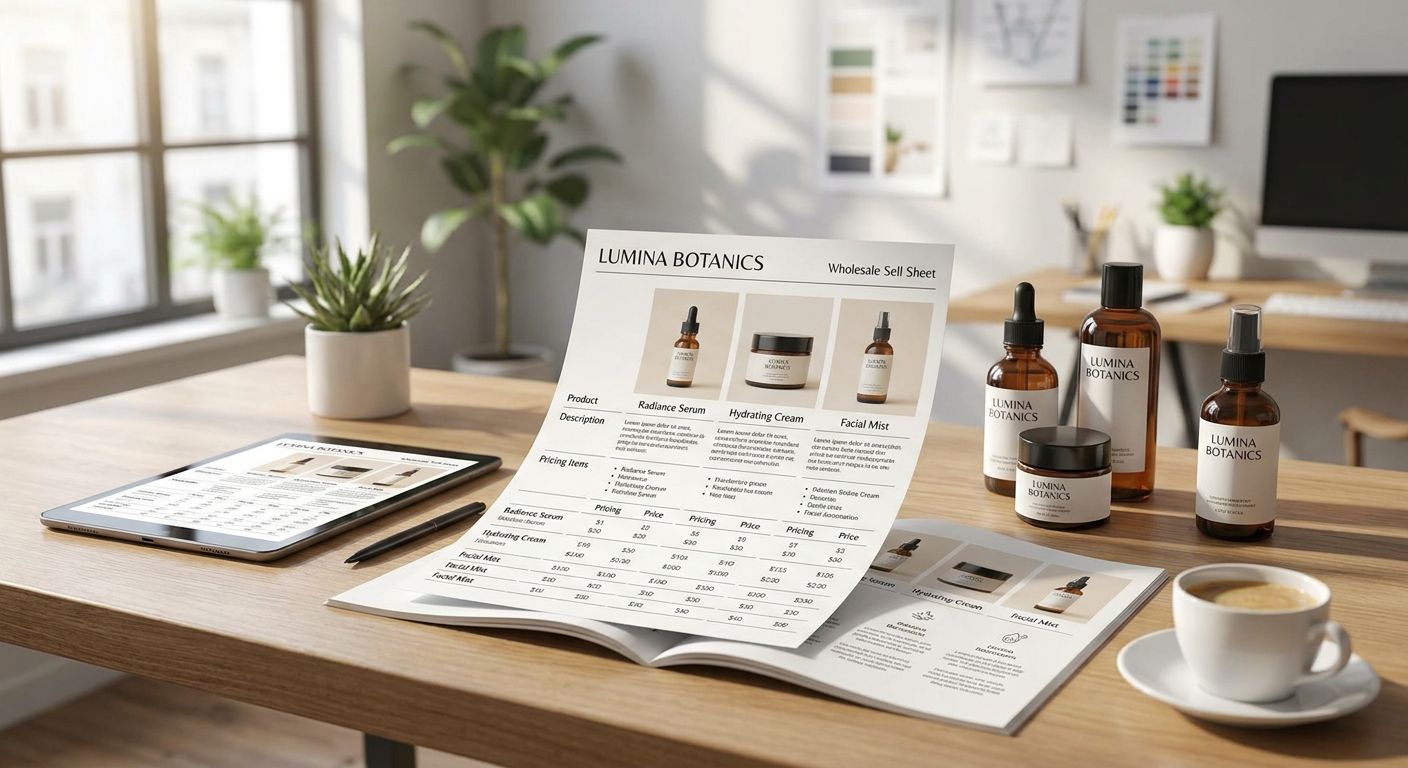
A wholesale sell sheet for a beauty brand is the single page that moves a buyer from "never heard of you" to "send me a line sheet" — it works only if SKUs, positioning, pricing structure, and terms are visible in the first ten seconds, whether that buyer is sourcing for Ulta, Sephora, or scrolling Faire in 2026.
- A wholesale sell sheet for a beauty brand fits one 8.5 x 11-inch page with SKUs, case packs, and terms visible immediately.
- Buyers reject sheets missing a 12-digit UPC, case pack structure, or lead times more often than they reject weak branding.
- Faire, Sephora, and Ulta buyers skim differently — build one master sheet and swap the cover line and hero SKU per channel.
- The Darl treats the sell sheet as one output of a wholesale marketing system, not a standalone PDF a founder builds alone.
Why this matters
A wholesale buyer reviews dozens of new lines in a single sourcing cycle, and a beauty brand that shows up in 2026 without a clean, one-page pitch gets skipped before the meeting starts. The sell sheet is not marketing collateral — it is the document a buyer forwards internally to get your line approved, so every field on it has to answer a question their finance or planning team will ask.
Most indie beauty brands treat the sell sheet as a design exercise. The beauty marketing agency work that actually gets lines picked up treats it as a sourcing document first and a brand moment second — the buyer decides on facts, not on how pretty the layout is.
How to build a wholesale sell sheet for a beauty brand
Build the sheet in this order, and don't skip a field because it feels premature — a missing field is the most common reason a buyer sets a sheet aside without responding.
- Lead with the buyer's question, not your founder story. Open with the hero SKU or bestseller, not a brand narrative. Buyers scan for product and terms first; the story lives in your media kit, not here.
- Lock the format to one page, 8.5 x 11 inches. This is the standard trade format buyers expect to forward as a single attachment. Anything longer gets treated as a catalog and read later, if at all.
- Export print-ready at 300 DPI. Buyers print sheets for internal review meetings, and a sheet that pixelates at 300 DPI reads as unfinished, regardless of the product inside it.
- Assign a 12-digit UPC to every SKU on the sheet. A UPC-A code is what a buyer's system needs to load your product — a sheet without one gets forwarded back with a request that stalls your timeline by weeks.
- State case pack structure clearly. Buyers need to know the unit count per case before they can model shelf space or a purchase order; leave the field blank and they'll assume you haven't built out fulfillment yet.
- Show margin structure in plain language. Reference your keystone or wholesale-to-retail markup approach without publishing specific figures on the sheet itself — most brands keep exact pricing in a follow-up line sheet or quote, sent after the buyer expresses interest.
- Include shelf-ready packaging notes. Note whether product ships in a merchandising unit, a shipper case, or requires the retailer to build a display — this is a planogram decision buyers make before they say yes.
- Add terms language: payment terms, freight responsibility, and return policy pointer. Even a line that says "terms detailed in vendor agreement" tells the buyer the operational side is handled.
- Close with one point of contact and a link to your full catalog or line sheet. A QR code works for in-person trade shows; a direct link works for email pitches and Faire submissions.
The elements every beauty sell sheet needs
- Hero product image and one to two supporting lifestyle shots
- SKU list with UPC codes and case pack counts
- Category and positioning line (clean beauty, prestige, mass, etc.)
- Certifications or claims relevant to the category (cruelty-free, vegan, reef-safe)
- Margin structure described in general terms, not itemized dollar figures
- Shelf-ready or display packaging notes
- Terms summary: payment, freight, minimum order structure
- Contact information and a link or QR code to the full line sheet
A sell sheet with all eight elements gets forwarded internally; a sell sheet missing three or more gets a follow-up email asking for the same information, which slows the decision by a full buying cycle.
Why sell sheets get rejected in 2026
Buyers reject sell sheets for operational gaps, not creative ones. The recurring patterns:
- No UPC on any SKU — the buyer's system can't load the product without one
- No case pack structure — planning teams can't model shelf space or order quantity
- Inconsistent product photography across SKUs, which reads as an unfinished catalog
- No terms language at all, forcing the buyer to ask questions your sheet should have answered
- A sheet that reads as a full catalog instead of a curated pitch, which buyers set aside for later review that rarely happens
- No lead time or fulfillment note, which matters more heading into 2026 as retailers plan tighter inventory cycles
Getting these right is a wholesale marketing function, not a design task — it sits next to retail terms negotiation and buyer-facing media kits as part of the same pitch package.
“A sell sheet without a UPC and a case pack count isn't unfinished branding — it's an unfinished business.”
What's the difference between a sell sheet and a line sheet?
A sell sheet is a one-page pitch designed to get a buyer's attention and a first meeting; a line sheet is the fuller document that follows, itemizing every SKU, wholesale price, and order minimum across the full assortment. Send the sell sheet cold, and the line sheet once a buyer responds.
How long should a wholesale sell sheet be?
A wholesale sell sheet should be exactly one page, 8.5 x 11 inches, front side only. If a buyer needs more detail, that's what the line sheet and follow-up call are for — a multi-page sell sheet gets treated as a catalog and read later, if at all.
Do Faire, Sephora, and Ulta buyers need different sell sheets?
Build one master sell sheet and adjust the cover line and hero SKU per channel rather than building three from scratch. Faire buyers skim fast and favor clear case pack and margin language; Sephora and Ulta buyers weigh brand positioning and certifications more heavily, so lead with those on sheets headed their way.
Build a wholesale package that actually converts
Sell sheets, line sheets, and buyer pitch strategy built as one system.
FAQ
What is a wholesale sell sheet for a beauty brand?
A wholesale sell sheet is a one-page pitch document, typically 8.5 x 11 inches, showing a buyer your SKUs, UPCs, case pack structure, positioning, and terms so they can decide whether to request a full line sheet.
How much does it cost to make a wholesale sell sheet?
Cost depends on whether you design it in-house with a template or commission a designer and copywriter to build it as part of a wholesale marketing package; the labor and design time is the real cost, not the printing.
What size should a beauty brand sell sheet be?
A beauty brand sell sheet should be 8.5 x 11 inches, one page, printed or exported at 300 DPI so it reproduces cleanly when a buyer forwards or prints it.
Do I need a UPC code on my sell sheet?
Yes — every SKU on a wholesale sell sheet needs a 12-digit UPC-A code, because buyers can't load your product into their purchasing system without one.
Is a sell sheet the same as a media kit?
No, a sell sheet targets retail buyers with product and terms, while a media kit targets press and influencers with brand story and assets; a beauty brand typically needs both, built with different content.
Should pricing appear on a wholesale sell sheet?
Most brands keep exact wholesale pricing off the sell sheet and describe margin structure in general terms, saving itemized pricing for the line sheet sent after a buyer expresses interest.
How many SKUs should go on a sell sheet?
Feature a curated selection of your bestsellers and hero product rather than your full catalog — a sell sheet crowded with every SKU reads as a catalog and gets set aside for later review.
Do Faire sell sheets differ from Sephora sell sheets?
The core elements stay the same, but Faire buyers respond to clear case pack and margin language while Sephora and Ulta buyers weigh positioning and certifications more heavily, so the cover line should shift by channel.
One last thing
Build the UPC, case pack, and terms fields as selectable text in the PDF, not baked into a flattened image. Buyers copy those numbers straight into their purchasing systems in 2026, and a sell sheet that forces them to retype everything is the kind that gets set aside for a competitor's cleaner file.