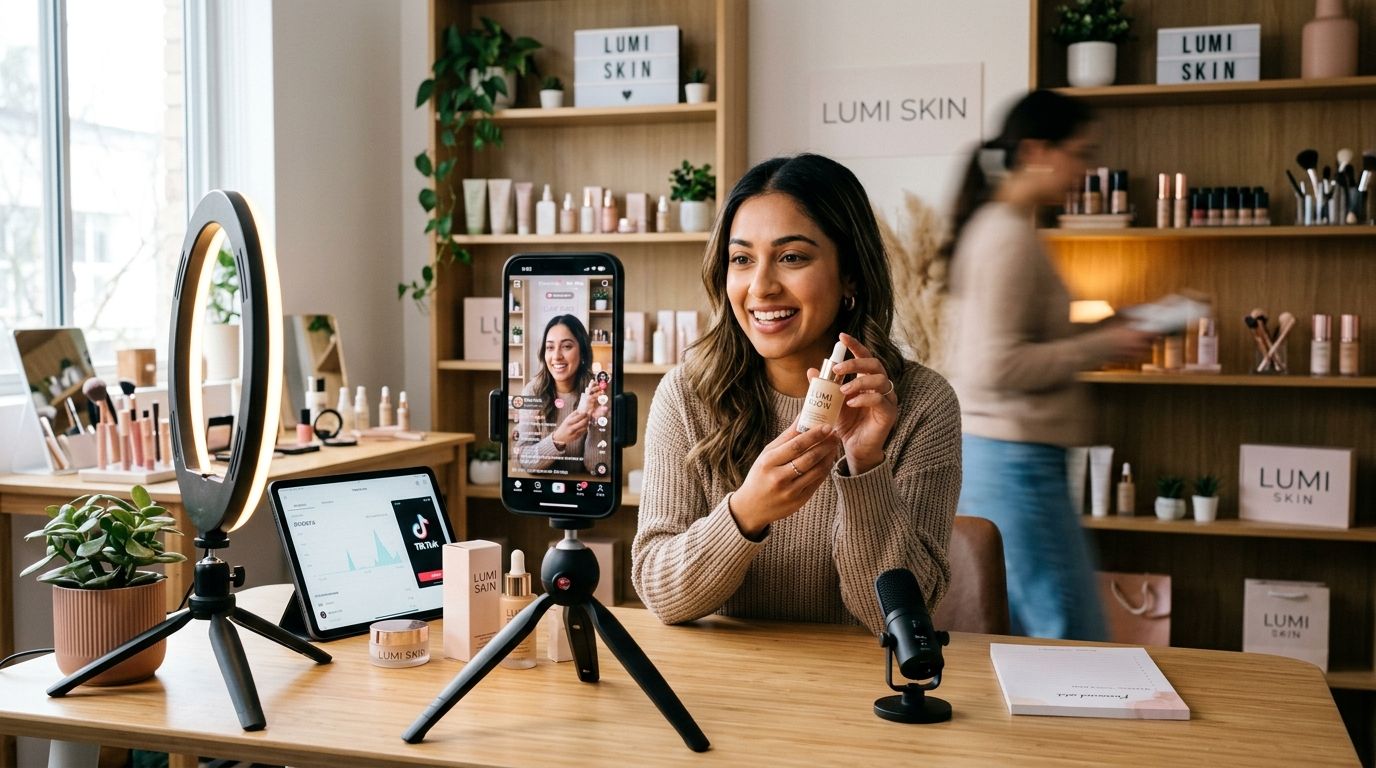
A marketing agency for CBD beauty brands builds growth systems around the platform bans, compliance gray zones, and payment-processor friction that generic beauty marketing playbooks ignore. Skincare and color cosmetics accounts test Meta and Google first; CBD topicals and cosmetics can't, so the channel sequence has to flip before a single dollar moves.
- A marketing agency for CBD beauty brands has to plan around Meta and Google ad bans on CBD terms in 2026.
- Email, SMS, and organic content carry more weight for CBD beauty brands than for standard DTC beauty accounts.
- PR and influencer seeding replace paid social as the primary discovery channel for CBD topicals.
- Retail entry at Sephora or Ulta requires CBD-specific compliance documentation most beauty agencies skip.
- The Darl builds omnichannel systems around SEO, email, PR, and affiliate that don't depend on banned ad accounts.
Why marketing matters for CBD beauty brands in 2026
Hemp-derived CBD has been federally legal since the 2018 Farm Bill, provided the product stays under 0.3% THC. That legal status hasn't changed how the ad platforms treat it. Meta and Google still restrict or flatly reject ads for CBD products regardless of THC content, and Amazon blocks most CBD listings outright. A marketing agency that only knows how to run a beauty brand's Meta account has nothing to offer here — the whole playbook has to be rebuilt around channels that don't require ad-account approval.
Search intent for CBD beauty terms also runs deeper than a typical skincare query. Buyers research THC content, sourcing, and third-party lab testing before they add to cart — more homework than a serum purchase usually requires. That shift in intent is exactly why SEO, content, and PR carry outsized weight for this segment compared to spray-and-pray paid social, and why a marketing agency for CBD beauty brands has to treat organic and owned channels as the primary engine, not the backup plan.
Audit your compliance exposure before you spend a marketing dollar
Do this before any campaign goes live in 2026, not after a platform flags the account.
- Confirm hemp-derived CBD content stays under the 0.3% THC threshold set by the 2018 Farm Bill
- Check state-level restrictions — several states still limit CBD cosmetics sales or require separate licensing
- Review FDA cosmetic labeling requirements: full ingredient list, net weight, manufacturer information
- Flag any "cures," "treats," or "heals" language in existing copy — the FDA treats these as drug claims, not cosmetic claims
- Confirm your payment processor and merchant account explicitly permit CBD transactions before scaling ad spend
Build owned channels before you build paid ones
Email and SMS survive platform bans. Ad accounts don't.
- Grow an email list around education (sourcing transparency, dosing guides) instead of a discount-only opt-in
- Layer SMS on top of email for restock and flash-sale messaging that Meta won't run as a paid ad
- Treat product pages as the top-of-funnel asset since Google Shopping and paid search largely won't carry CBD terms
- Build a subscriber-only content series a banned ad account can't touch
Pick ad channels that will actually run CBD creative
Not every paid channel says no. Test before assuming the door is closed everywhere.
- Test Microsoft Advertising and programmatic display networks with CBD-permissive policies before writing off paid media entirely
- Run affiliate and influencer partnerships as the substitute for banned paid social spend
- Use email and SMS retargeting instead of pixel-based Meta retargeting
- Recheck each platform's CBD policy before every launch — policies shift without notice, and last quarter's approval doesn't guarantee this quarter's
A paid media agency for wellness ecommerce brands that already navigates supplement and wellness ad restrictions is closer to the right fit than a generalist beauty shop that's never had an account suspended.
Invest in SEO and content since organic is your least restricted channel
Google doesn't ban organic content about CBD the way it restricts CBD ads.
- Target the questions buyers ask before purchase: "is CBD legal in [state]," "full spectrum vs isolate," "third-party lab testing"
- Publish lab-testing and Certificate of Analysis pages — this content ranks and builds trust in the same move
- Build comparison and dosing content, not just product description pages
- Structure content so it answers the exact question an AI assistant would summarize for a shopper researching CBD topicals
Use PR and influencer seeding to do what paid social can't
This is where discovery has to happen when the ad account is off the table.
- Pitch beauty and wellness editors on formulation and sourcing angles, not just launch announcements
- Seed product with micro-influencers who post organically where paid boosting isn't an option
- Build affiliate relationships with wellness publishers who already have earned trust with CBD-curious readers
- Track PR placements as a discovery channel, not a brand-awareness line item — it's replacing reach that ads used to buy
A PR launch built for a beauty brand does more heavy lifting for a CBD line than it would for a brand that can still run paid social freely.
Prepare for retail conversations differently than a typical beauty brand
Sephora and Ulta buyers ask CBD brands questions they don't ask a standard skincare line.
- Sephora and Ulta CBD assortments stay limited, and buyer conversations require documented compliance history
- Build a track record of clean online sales, lab testing, and press before pitching prestige retail
- Confirm state-by-state retail restrictions before promising a buyer national shelf space
- Bring wholesale-ready packaging and claims language already reviewed against FDA cosmetic guidance
Build a CBD beauty growth plan
Get an omnichannel plan built around ad restrictions, not despite them.
Marketing options for CBD beauty brands in 2026
| Option | Best for | Key limitation |
|---|---|---|
| Full-service omnichannel agency (e.g., The Darl) | Brands ready to run SEO, email, PR, and affiliate as one connected system | Needs budget spread across content and PR, not just ad spend |
| Freelance CBD compliance consultant | A one-time regulatory or labeling audit | Doesn't build or run ongoing marketing channels |
| In-house content/SEO hire | Brands with an existing audience and a slower growth timeline | Can't move fast on multi-channel launches or PR |
| Boutique CBD-only marketing shop | Deep category expertise on THC and hemp regulation | Often lacks broader prestige beauty retail experience |
The verdict: a full-service marketing agency for CBD beauty brands beats a single-channel specialist once you're trying to run SEO, PR, email, and affiliate as one system instead of four disconnected vendors.
Common mistakes CBD beauty brands make
- Running Meta or Google campaigns with "CBD" in the creative text and getting the whole ad account flagged, not just the one ad
- Treating email and SMS as an afterthought instead of the primary replacement for banned paid social reach
- Using disease or treatment language ("relieves anxiety," "treats inflammation") that reads as an FDA drug claim, not a cosmetic claim
- Skipping third-party lab testing documentation, which slows both retail conversations and organic trust-building
- Pitching Sephora or Ulta before building the online sales history and compliance record buyers expect to see first
FAQ
What's the best marketing agency for CBD beauty brands in 2026?
The best fit is a full-service marketing agency that already runs SEO, email, PR, and affiliate as connected channels, since CBD brands can't rely on Meta or Google ads the way most beauty accounts do. A single-channel freelancer or a paid-media-only shop leaves the compliance and retail work unhandled.
Can CBD beauty brands run Facebook or Instagram ads?
Rarely, and never reliably. Meta restricts or rejects most CBD product ads regardless of THC content, and an account can get flagged for using the word CBD in creative text even when the product itself is compliant.
Is SEO better than paid ads for CBD beauty brands?
SEO is the more dependable channel because Google doesn't ban organic content about CBD the way it restricts CBD ads. Buyers researching sourcing, THC content, and lab testing tend to search before they buy, which favors content and search over paid social.
Can CBD beauty brands get into Sephora or Ulta?
It's possible but limited, and buyers expect documented compliance history, lab testing, and a proven online sales record before they'll consider shelf space. State-by-state restrictions also affect what a retailer can carry in different markets.
What channels work best for CBD topical products?
Email, SMS, organic search, PR, and affiliate partnerships carry the most weight since they don't depend on ad-account approval. Influencer seeding also works because organic posts aren't subject to the same review as paid boosts.
Do CBD beauty brands need FDA approval?
Cosmetics don't require FDA premarket approval, but they do need accurate labeling and can't carry disease or treatment claims. Any language suggesting a product cures, treats, or heals a condition risks being classified as an unapproved drug claim.
How is marketing a CBD beauty brand different from marketing a regular skincare brand?
A regular skincare brand can build its funnel around Meta and Google ads from day one. A CBD beauty brand has to build owned channels and organic discovery first because paid social and Amazon listings are restricted or banned outright.
How much does a marketing agency for CBD beauty brands typically handle?
Scope varies by agency, but a full-service engagement usually covers SEO, content, email/SMS, PR, and affiliate management together rather than a single channel. Check current scope and pricing directly with the agency since it depends on the brand's stage and channel mix.
One last thing
Meta and Google review CBD ad accounts case-by-case, not category-wide — two brands selling nearly identical topical products can get opposite verdicts from the same review team in the same week. Don't build a 2026 marketing plan around the assumption that a competitor's approved ad account means yours will pass too; build the owned-channel base regardless of what the ad review says.