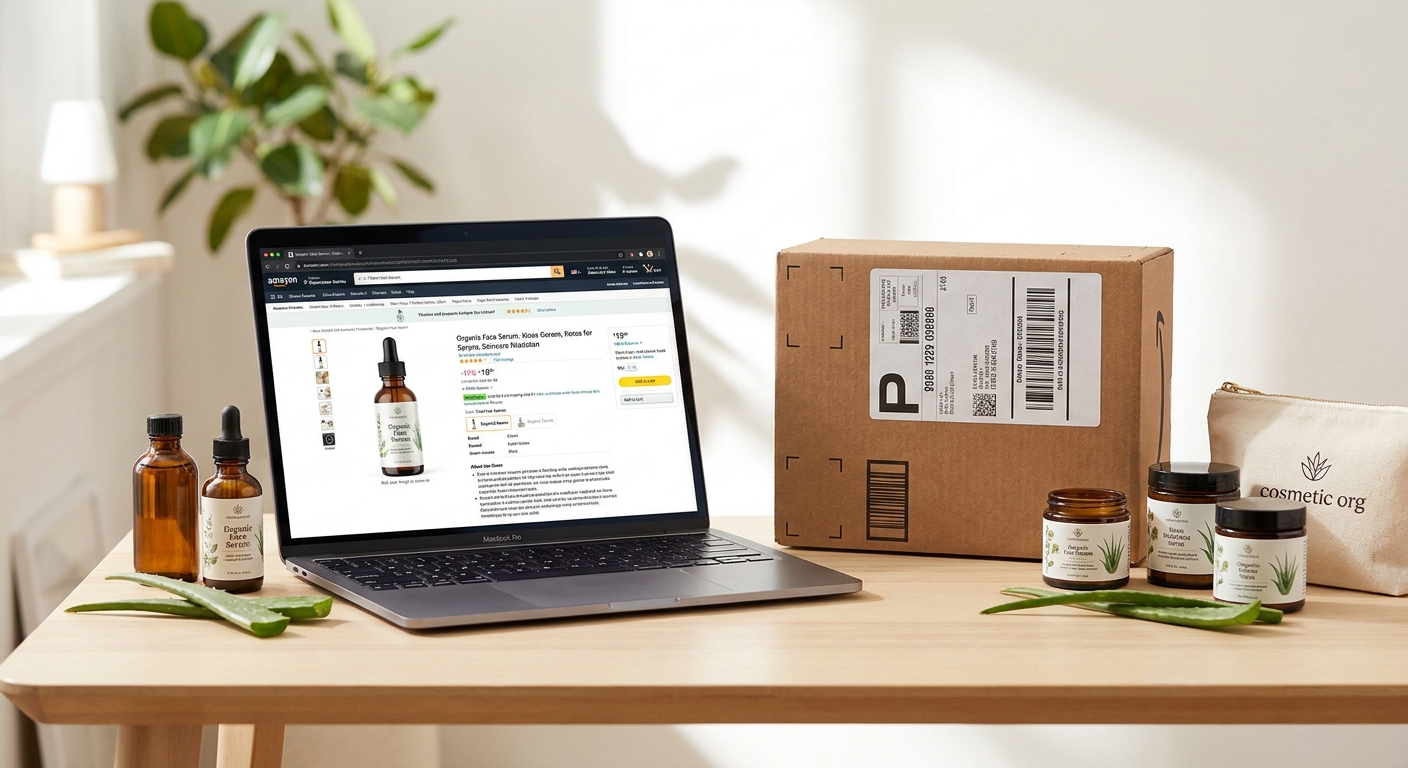
Amazon marketing for skincare brands in 2026 isn't a side channel anymore — it's a search engine, a review engine, and a discovery engine that either compounds with your DTC ecosystem or fights against it. Get the setup wrong and you're burning ad spend on a storefront nobody trusts.
- Amazon marketing for skincare brands starts with Brand Registry and A+ Content — skip these and shoppers can't trust the listing. Buy.
- Sponsored Products on concern keywords like retinol, niacinamide, and vitamin C drives the discovery skincare shoppers actually search by. Buy.
- Amazon Vine caps review seeding at 30 units per enrollment in 2026 — useful at launch, not a scale strategy. Consider.
- Subscribe & Save discounts of 5-15% fit skincare's repurchase cycle better than one-off Lightning Deals. Buy.
- Running Amazon as a silo separate from DTC and social loses the compounding effect entirely. Skip that approach.
Why this matters
Skincare buys differently than most Amazon categories. Shoppers search by concern ("dark spots," "hormonal acne") and ingredient ("retinol," "azelaic acid"), not brand name, which means the keyword layer matters more here than in almost any other vertical on the platform. A brand with strong DTC positioning but a thin Amazon listing loses that shopper to a competitor with better A+ Content, even when the product itself is worse.
The brands that treat Amazon marketing for beauty brands as its own coordinated channel — not a dumping ground for excess inventory — see it reinforce email, paid social, and search instead of competing with them. That's the ecosystem effect: Amazon reviews build trust that shows up in Google search snippets, and Amazon search terms tell you what your DTC site copy is missing.
Who this is for
This guide is for skincare brands already selling direct-to-consumer that are either entering Amazon for the first time in 2026 or sitting on an underperforming listing they haven't touched since launch. If you're doing under $50,000 a month on Amazon and can't explain your ACOS by category, this is your starting point.
What to look for in Amazon marketing for skincare brands
Brand Registry and IP protection status
Without Brand Registry, you can't run A+ Content, Sponsored Brands, or Vine — full stop. It requires an active trademark and typically clears in 4-8 weeks in 2026, so this is the first thing to check before building any Amazon strategy on top of it. Skincare brands especially need this because counterfeit and hijacked listings target high-margin actives categories.
Ingredient and claims compliance
Skincare sits closer to FDA cosmetic regulation than almost any other Amazon category, and Amazon's own listing policies restrict SPF and drug-claim language beyond what FTC rules already require. A listing claiming to "treat" or "cure" a skin condition gets suppressed or delisted — the safe language is cosmetic and cosmetic-adjacent only.
Review velocity and compliant generation
Skincare shoppers read reviews harder than almost any other category because results are visible on their face. Review generation has to run through Amazon-compliant channels — Vine, post-purchase inserts that don't request positive reviews, and Amazon's own request-a-review button — because incentivized reviews outside those channels risk account suspension.
Subscribe & Save and repurchase mechanics
Skincare is a repurchase category by nature — a serum or moisturizer runs out in 30-60 days. Subscribe & Save discounts of 5-15% capture that repeat cycle directly inside Amazon instead of losing the customer back to a competitor's search result next month.
PPC depth on concern and ingredient keywords
Generic category terms like "face moisturizer" are expensive and low-intent. The keyword depth that actually converts sits in concern and ingredient combinations — "vitamin C serum for dark spots," "retinol cream sensitive skin" — and that's where Sponsored Products budget should concentrate.
A+ Content built for routines, not just specs
Skincare shoppers want to see how a product fits into a routine — what comes before it, what comes after, how fast results show. A+ Content modules that show routine sequencing outperform modules that just list ingredients in a bullet grid.
Top picks: the Amazon programs skincare brands should prioritize in 2026
Brand Registry + A+ Content — the non-negotiable. This is the foundation every other program sits on top of, and it's the difference between a listing that converts and one that gets buried by a copycat. Approval runs 4-8 weeks with an active trademark. Buy.
Sponsored Products and Sponsored Brands on concern keywords — the workhorse. Skincare shoppers search by problem and ingredient, and this is where budget converts fastest when the paid media agency for skincare startups approach targets long-tail concern terms instead of broad category match. Buy.
Amazon Vine — the launch tool, not the scale tool. Vine caps enrollment at 30 review units per product in 2026, which is enough to seed initial social proof on a new SKU but won't move a listing with zero reviews to page one on its own. Consider.
Subscribe & Save — the repurchase capture. With discounts running 5-15%, this locks in the second and third purchase before a competitor's ad ever reaches your customer, and it pairs directly with the kind of lifecycle marketing for beauty subscription brands work that keeps DTC subscribers retained too. Buy.
Brand Referral Bonus for external traffic — the underused lever. Amazon credits a bonus, commonly cited around 10%, on sales driven by traffic you send from outside the platform, which means social media marketing for skincare brands content pointed at an Amazon listing earns a discount most brands never claim. Consider.
Get an Amazon audit for your skincare brand
See where your listing, PPC, and review strategy are leaking budget in 2026.
What to avoid
- Incentivized reviews outside Vine or the request-a-review button. It looks like a shortcut and it's the fastest way to trigger a suspension investigation on a skincare account.
- Broad-match PPC with no negative keyword list. Skincare terms are expensive and adjacent categories (haircare, makeup) will eat budget without tight negatives.
- Running Amazon in isolation from DTC. A listing that never gets its search-term data fed back into site SEO or email subject lines is leaving free market research on the table.
How the programs stack up
| Program | Setup Effort | Cost Signal | Best For | Verdict |
|---|---|---|---|---|
| Brand Registry + A+ Content | Medium (4-8 wks) | Low ongoing cost | Trust and conversion | Buy |
| Sponsored Products/Brands | Low to start | Scales with ACOS target | Concern/ingredient discovery | Buy |
| Amazon Vine | Low | Free unit cost only | New launch social proof | Consider |
| Subscribe & Save | Low | 5-15% discount cost | Repurchase capture | Buy |
| Brand Referral Bonus | Medium | ~10% credit back | External traffic monetization | Consider |
FAQ
What's the best Amazon marketing strategy for skincare brands in 2026?
The best strategy pairs Brand Registry and A+ Content as the foundation with Sponsored Products bidding on concern and ingredient keywords. Subscribe & Save then captures the repurchase cycle that skincare's 30-60 day usage window creates.
How much does Amazon PPC cost for skincare brands?
Cost depends entirely on keyword competitiveness, but generic category terms like face moisturizer run far more expensive than concern-specific long-tail terms. Budget should weight toward the long-tail where ACOS stays closer to your product margin.
Is Amazon Vine worth it for a new skincare launch?
Yes for the first 30 units of social proof a new listing needs, but Vine enrollment is capped at 30 review units per product in 2026. It's a launch tool, not a way to build hundreds of reviews.
Does Subscribe & Save help skincare brands on Amazon?
Yes, because skincare products run out on a predictable 30-60 day cycle and Subscribe & Save discounts of 5-15% lock in that repeat purchase before a competitor's ad reaches the customer first.
Can skincare brands sell active-ingredient products on Amazon without FDA issues?
Yes, as long as listing copy stays in cosmetic language and avoids drug-style claims like treat or cure. Amazon's own policy enforcement on skincare claims is often stricter than baseline FTC rules.
Is Amazon marketing better than DTC marketing for skincare brands?
Neither replaces the other — Amazon captures search-driven discovery shoppers while DTC builds the brand relationship and margin. The strongest 2026 approach feeds Amazon search-term data back into DTC SEO and email content.
How long does Amazon Brand Registry approval take?
Approval typically takes 4-8 weeks in 2026 once you have an active trademark filed. Nothing else on this list — A+ Content, Sponsored Brands, Vine — unlocks until Brand Registry clears.
What is the Brand Referral Bonus and does it matter for skincare?
It's a credit, commonly cited around 10%, that Amazon pays back on sales driven by traffic you send in from outside the platform. Skincare brands running social content that links to an Amazon listing are usually leaving this credit unclaimed.
One last thing
The skincare brands actually winning on Amazon in 2026 aren't the ones with the biggest PPC budget — they're the ones pulling Amazon's search-term reports and feeding them straight into DTC site copy and email subject lines, closing a loop most brands run as two disconnected playbooks.