Amazon isn't a side channel for beauty brands anymore — it's often the second-biggest revenue line after DTC, and most founders are still guessing at which levers actually move it. This guide ranks the Amazon marketing strategies that work for beauty brands in 2026, from listing optimization to Amazon DSP, with a clear verdict on each.
- Amazon SEO and A+ Content are the foundation — skip them and every dollar of ad spend works harder than it should.
- Sponsored Products plus Sponsored Brands is the highest-ROI combo for beauty brands launching or scaling on Amazon in 2026.
- Amazon Vine (30-unit cap per parent ASIN) is the fastest way to seed reviews before a launch — Buy for new SKUs.
- Amazon DSP only pays off past roughly $50K/month in Amazon revenue — Wait until you're there.
- Subscribe & Save is close to mandatory for skincare and haircare brands chasing repeat purchase.
Why this matters
Beauty shoppers behave differently on Amazon than in a DTC checkout — they compare star ratings, scroll past the fourth listing, and buy from whoever wins the Buy Box on repeat orders. A brand with a strong Shopify funnel can still bleed share on Amazon if the listing, reviews, and ad structure aren't built for how Amazon actually ranks and converts.
Amazon marketing for beauty brands in 2026 means treating the channel as its own ecosystem — search, ads, reviews, and external traffic all reinforcing each other — not a listing you set up once and forget. The brands winning share right now are the ones running Amazon like a second storefront, with its own content, its own funnel, and its own KPIs.
How we ranked these strategies
Each strategy below is scored on three things: how fast it produces a measurable lift in conversion rate or organic rank, how much it costs relative to typical beauty margins, and how well it holds up across skincare, color cosmetics, and haircare — the three sub-categories where Amazon behavior differs most. Strategies that only work for one sub-category or one price tier get flagged. The verdicts assume a beauty brand doing at least $10K/month in Amazon revenue; pre-launch brands should read the Vine and listing sections first.
The ranked list
1. Amazon SEO and listing optimization — the foundation
Backend search terms, title structure, and bullet points still decide whether Amazon's A9 algorithm surfaces a listing before a single ad dollar is spent. A beauty listing missing backend keywords for ingredient terms (retinol, niacinamide, squalane) loses organic placement to competitors who bothered to fill the field. This is the cheapest lever on the list and the one most brands skip in 2026 because it isn't glamorous. Buy — do this before spending on ads.
2. A+ Content and Amazon Storefront
A+ Content modules let a beauty brand show ingredient callouts, before/after imagery, and comparison charts directly on the listing, and Amazon's own data has long tied A+ Content to conversion lifts in the double digits for cosmetics and skincare. A built-out Storefront also gives you a destination for external traffic instead of dumping paid clicks onto a single ASIN page. Buy — pair it with the listing work in step one.
3. Sponsored Products (Amazon PPC)
Sponsored Products is still the highest-volume ad type on Amazon and the fastest way to buy visibility while organic rank catches up. Beauty categories run competitive on head terms like "vitamin c serum" or "clean shampoo," so a realistic target ACOS sits around 25-30% once campaigns mature past the first 60 days. Automatic and manual campaigns running in parallel, with negative keywords pruned weekly, is what separates a profitable account from one that bleeds spend on irrelevant search terms. Buy — non-negotiable for any brand serious about the channel.
4. Sponsored Brands and video ads
Sponsored Brands puts your logo, headline, and up to three products at the top of search results — the only ad unit that builds brand recall instead of just clicks. Video variants convert well for beauty because they can show texture, application, and finish in a way static images can't. This is a second-tier spend after Sponsored Products is stable, not a replacement for it. Buy — once core PPC is profitable.
5. Amazon Vine for review seeding
Vine lets enrolled sellers give up to 30 units of a new ASIN to Amazon's vetted reviewer pool, and it remains the fastest legitimate path to the review volume a new beauty listing needs to convert. A skincare launch with zero reviews converts at a fraction of the rate of one with 15-20 genuine reviews and a 4+ star average. Brands running an amazon marketing for skincare brands launch plan in 2026 should enroll in Vine before the first PPC dollar goes out. Buy — for any new SKU launching in 2026.
6. Subscribe & Save enrollment
Subscribe & Save fits consumable beauty categories — skincare, haircare, and body care — better than color cosmetics, since repeat purchase cadence is built into the product itself. Enrolling ASINs with a 5-15% discount tier increases repeat rate and gives Amazon a signal that boosts organic ranking for recurring searches. Color cosmetics brands can mostly skip this one. Buy for skincare/haircare, Skip for most color cosmetics SKUs.
7. Amazon DSP for retargeting
Amazon DSP lets you retarget shoppers who viewed your listing but didn't buy, both on and off Amazon, using Amazon's first-party shopping data. It's a real lever, but the minimum spend and management overhead only pencil out once a brand is doing roughly $50K or more per month in Amazon revenue. Below that threshold, the same budget performs better in Sponsored Products. Wait — until Amazon revenue clears that scale.
8. Amazon Posts and Live
Posts and Live shopping are Amazon's answer to social commerce — free organic content placement and live-stream selling inside the app. Adoption among beauty shoppers is still building in 2026 compared to Sponsored Products or A+ Content, and the format rewards brands that already have a content engine running elsewhere. Worth testing if content is already produced for other channels; not worth building from scratch just for Amazon. Consider — free to test, low priority to build for.
“A beauty listing with zero reviews and perfect ad spend still loses to a mediocre listing with fifteen reviews.”
Comparison table
| Strategy | Cost tier | Time to results | Best for | Verdict |
|---|---|---|---|---|
| SEO & listing optimization | Low | 2-4 weeks | All beauty categories | Buy |
| A+ Content & Storefront | Low-Medium | 3-6 weeks | Skincare, color cosmetics | Buy |
| Sponsored Products | Medium-High | 30-60 days to maturity | All beauty categories | Buy |
| Sponsored Brands & video | Medium | 60-90 days | Established listings | Buy |
| Amazon Vine | Low (unit cost) | 2-4 weeks | New launches | Buy |
| Subscribe & Save | Low | Ongoing | Skincare, haircare | Buy (skip for cosmetics) |
| Amazon DSP | High | 90+ days | $50K+/mo brands | Wait |
| Amazon Posts & Live | Low | Slow, organic | Brands with content engines | Consider |
Getting this built out right
Most beauty brands try to run Amazon as a side task for whoever manages the DTC store, and it shows in inconsistent ACOS and stale listings.
- In-house works once you're doing $20K+/month on Amazon and can dedicate someone full-time to bid management and content refreshes.
- A specialized team pays off below that threshold, because the setup cost of PPC structure, A+ Content, and Vine enrollment is the same whether you're doing $5K or $50K a month — spreading it across an agency's existing systems is cheaper than building it from zero.
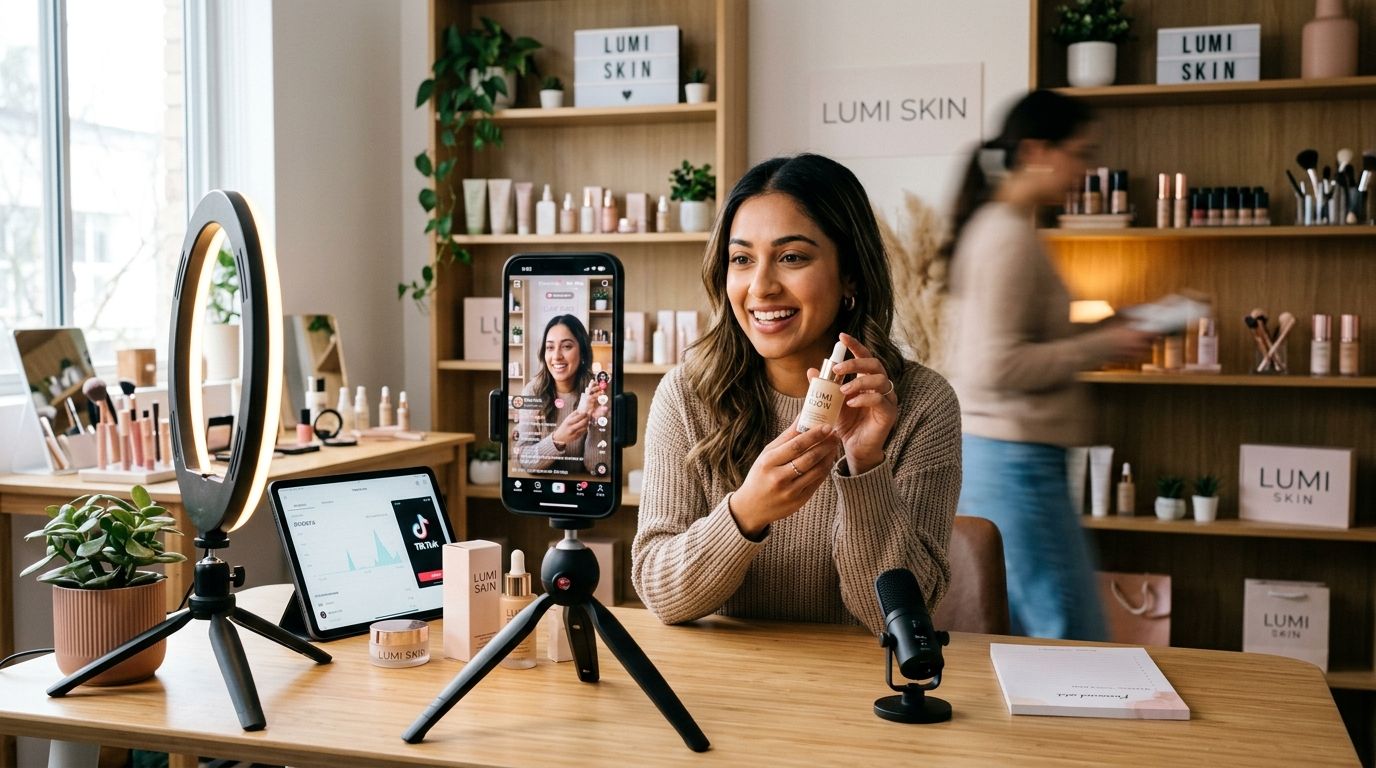
- Never run Amazon in isolation from the rest of the brand's marketing — reviews sourced through influencer seeding, UGC pushed into A+ Content, and social proof from TikTok all feed Amazon conversion rate whether or not the ad account tracks it.
Get an Amazon growth plan built for beauty
See where PPC, listings, and reviews are leaving revenue on the table.
FAQ
What's the best Amazon marketing strategy for beauty brands in 2026?
Listing SEO and A+ Content come first, followed by Sponsored Products and Amazon Vine for review seeding. Together these four cover the highest-ROI ground before you move into DSP or Live shopping.
Is Amazon Vine worth it for a beauty brand launch?
Yes, Vine is worth it for most new beauty launches in 2026. The 30-unit cap per parent ASIN is enough to build the 15-20 review base that meaningfully lifts conversion rate.
How much does Amazon PPC cost for a beauty brand?
Target ACOS for beauty PPC in 2026 sits around 25-30% once campaigns mature past 60 days. Actual spend scales with category competitiveness — skincare head terms cost more per click than niche haircare terms.
Is Amazon DSP worth it for smaller beauty brands?
No, not usually below roughly $50K/month in Amazon revenue. Below that threshold the same ad budget performs better inside Sponsored Products.
Does Subscribe & Save work for color cosmetics?
Not as well as it works for skincare or haircare. Color cosmetics purchase cycles are less predictable, so the repeat-purchase discount has less to work with.
Should a beauty brand hire an agency for Amazon or run it in-house?
In-house makes sense past roughly $20K/month in Amazon revenue with a dedicated operator. Below that, a specialized team spreads setup cost across existing systems and gets to profitable ACOS faster.
Do Amazon reviews really affect ranking, not just conversion?
Yes. Review count and rating feed into Amazon's ranking signals alongside sales velocity, which is why Vine-seeded reviews on a new launch also help organic placement.
What's the biggest mistake beauty brands make on Amazon?
Running Sponsored Products against a listing with weak backend keywords and no A+ Content. The ad spend covers for a listing problem instead of fixing it, so ACOS stays high indefinitely.
One last thing
The brands winning Amazon share in 2026 aren't the ones with the biggest ad budgets — they're the ones feeding Amazon proof from everywhere else. A skincare brand pushing UGC into A+ Content and seeding reviews through influencer partnerships converts better on identical ad spend than one running PPC in isolation, because Amazon's algorithm and its shoppers both reward external validation showing up inside the listing.