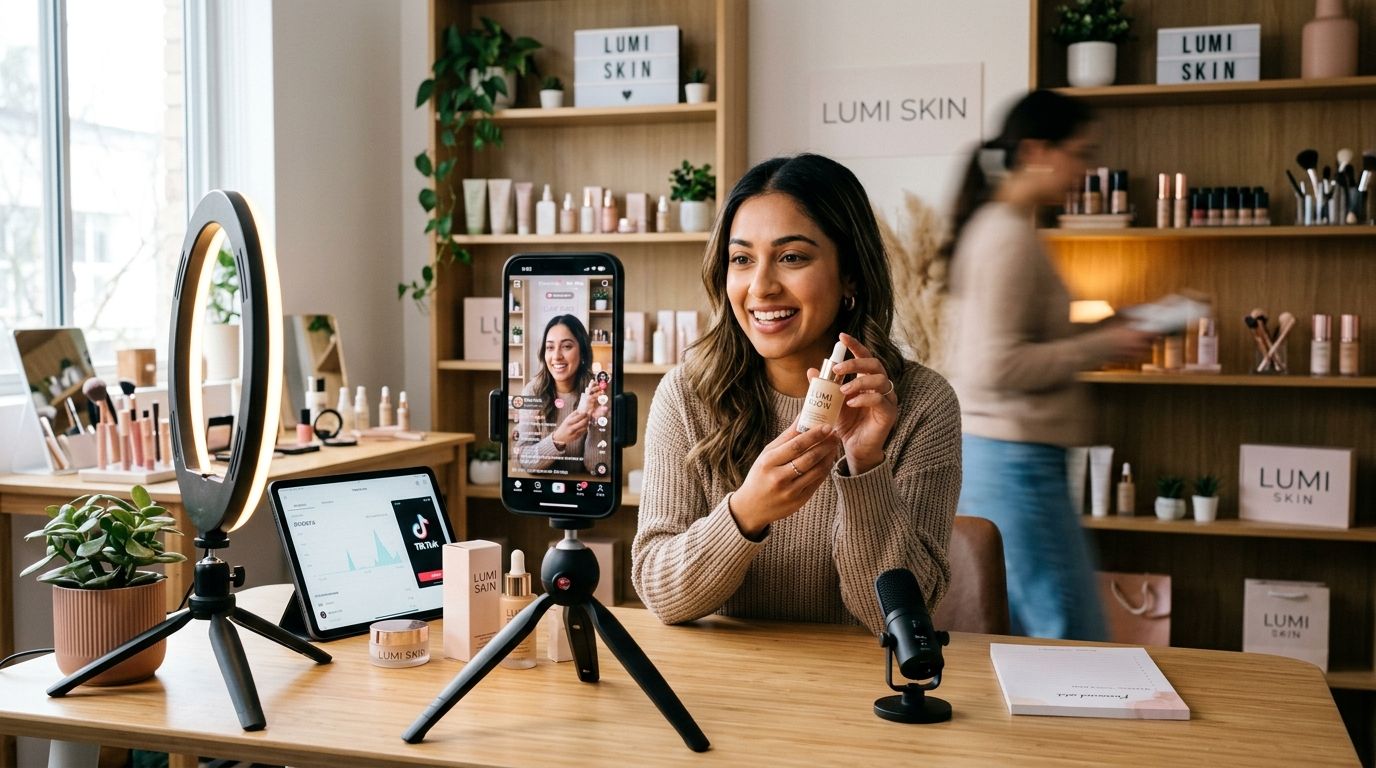
Entering the US is where most luxury beauty brands either build the moat that keeps them relevant for a decade or burn eighteen months of runway on the wrong retail bet. A US market entry plan for a luxury beauty brand needs five locked phases before a single dollar goes to media: positioning validation, regulatory and operations setup, channel and retail strategy, launch sequencing, and post-launch scale. Skip the regulatory phase and you'll rebuild packaging after FDA cosmetic labeling review flags an ingredient claim six weeks before your Sephora ship date.
- A US market entry plan for a luxury beauty brand runs five phases: positioning, regulatory setup, channel strategy, launch sequencing, post-launch scale.
- Retail negotiations with Sephora and Ulta buyers should start 9-12 months before any shelf date, not after.
- DTC and paid media validate demand before retail conversations happen — buyers ask for sell-through proof, not a pitch deck.
- PR and press seeding need to run in parallel with retail, not after it, or launch week has no earned media to point to.
- The Darl builds omnichannel entry plans for prestige beauty brands scaling into the US in 2026.
Why this matters
Most founders treat US market entry as a media budget question. It isn't. It's a sequencing question, and the brands that get the sequence wrong end up negotiating retail terms with no US sales data, launching PR with no product on shelf, or running paid social to a site that can't process the tax and duty logic a luxury price point requires.
A marketing agency for luxury beauty brands in the US builds the entry plan around proof points a retail buyer or a press editor will actually ask for: DTC traction, review velocity, a defensible positioning gap. That order matters more in 2026 than it did five years ago, because Sephora and Ulta buyers now expect a minimum of six months of US sell-through data before they'll talk shelf space with an international brand.
Building a US market entry plan for a luxury beauty brand
The plan breaks into five phases, run roughly in this order with real overlap between phases three and four.
- Positioning validation — confirm the US whitespace gap against category incumbents before spending on anything.
- Regulatory and operations setup — FDA cosmetic labeling, ingredient compliance, US-based fulfillment and returns logic.
- Channel and retail strategy — DTC-first proof of demand, then a retail conversation with Sephora, Ulta, or a curated boutique network.
- Launch sequencing — PR, influencer seeding, paid media, and email all firing in a coordinated window, not staggered.
- Post-launch scale — loyalty, retention, and the second-year retail expansion built off first-year data.
| Phase | Primary owner | Typical duration |
|---|---|---|
| Positioning validation | Brand strategy | 4-6 weeks |
| Regulatory & operations | Legal/ops | 8-12 weeks |
| Channel & retail strategy | Growth + retail | 3-4 months |
| Launch sequencing | PR + paid + email | 6-8 weeks |
| Post-launch scale | CRM + loyalty | Ongoing |
Every phase produces a document a retail buyer, an investor, or a press contact can read cold. That's the test: if the deliverable only makes sense with the founder in the room explaining it, it's not done.
Phase 1: Positioning validation
Before a single ad runs, confirm the brand owns a gap US shoppers can't already fill with an incumbent. A French or Korean prestige brand with a clean formulation angle competes differently in the US than it does at home — the clean beauty conversation here is louder and more skeptical than in most European markets. This is the same groundwork covered in brand strategy for prestige beauty brands: confirm the gap, then build the entry plan around defending it.
Phase 2: Regulatory and operations setup
FDA cosmetic labeling rules, ingredient restriction lists, and country-of-origin claims all need sign-off before packaging goes to print for the US market. Fulfillment matters just as much: a luxury brand shipping from Europe with 10-14 day delivery windows loses to a domestic competitor shipping in 2-3 days, every time, regardless of formula quality.
Phase 3: Channel and retail strategy
DTC comes first because it's the only channel that generates the sell-through data a retail buyer will actually request. Six to nine months of US-based DTC sales, review counts, and repeat-purchase rate gives a Sephora or Ulta buyer something concrete to evaluate instead of a brand deck. The mechanics of that conversation are covered in how to negotiate retail terms with Sephora and Ulta buyers, and the operational side of the shelf placement itself sits in retail marketing for beauty brands entering Sephora.
Phase 4: Launch sequencing
PR, influencer seeding, paid social, and email all need to hit in the same two-to-three week window. A PR launch for a beauty brand that runs a month before paid media starts wastes the earned-media spike — by the time ads go live, the press cycle has already cooled.
Get a US entry plan built
See how The Darl sequences positioning, retail, and launch for prestige beauty brands.
Phase 5: Post-launch scale
Year-one US data drives the year-two retail expansion, the loyalty program build, and the CRM segmentation strategy. Skip this phase and the brand plateaus at the first retail door instead of expanding the footprint.
Why market entry timelines vary
Not every luxury beauty brand runs the same five-phase timeline at the same speed. A few factors change how long each phase actually takes:
- Formula complexity — novel actives or unusual ingredient sourcing extend the regulatory phase past the typical 8-12 weeks.
- Existing US press relationships — brands with prior US editor contacts compress the PR runway; brands starting cold need longer lead time.
- Retail ambition — a Sephora-first strategy demands more DTC proof upfront than a boutique or specialty retail strategy.
- Price point — higher price points need a longer DTC validation window because repeat-purchase data takes longer to accumulate.
- Team bandwidth — an in-house team juggling entry alongside existing markets moves slower than a brand with a dedicated agency partner running the sequence.
- Category crowding — a saturated category (fragrance, clean skincare) needs a sharper positioning phase before any channel spend starts.
Related questions
How long does a US market entry plan take for a luxury beauty brand?
A full sequence from positioning validation to first retail conversation runs roughly 9-12 months in 2026, with DTC validation alone taking 6-9 months before a Sephora or Ulta buyer will engage. Brands that compress this timeline usually do so by skipping DTC proof, which weakens the retail negotiation.
Should a luxury beauty brand launch DTC or retail first in the US?
DTC first is the standard sequence, because retail buyers now expect sell-through data before granting shelf space. An omnichannel marketing for prestige skincare brands approach treats DTC as the proof engine that funds and justifies the retail conversation, not a parallel track.
Does a luxury beauty brand need a US-based marketing agency to enter the market?
A US-based agency isn't mandatory, but it removes the guesswork on FDA labeling nuance, retail buyer expectations, and press relationships that international teams often underestimate. The considerations for picking that partner are covered in how to choose a marketing agency for your beauty brand.
FAQ
What's the first step in a US market entry plan for a luxury beauty brand?
The first step is positioning validation — confirming the brand owns a gap US shoppers can't already fill with an existing prestige competitor. Skipping this step means every later phase, from regulatory to retail, gets built on an unproven premise.
How much US DTC data does a brand need before approaching Sephora or Ulta?
Buyers typically want 6-9 months of US-based DTC sales, review velocity, and repeat-purchase data before a serious retail conversation starts in 2026. Less than that, and the pitch reads as speculative rather than proven.
Is FDA cosmetic labeling different for imported luxury beauty products?
Imported luxury beauty products need US-compliant labeling and ingredient disclosure regardless of what's already approved in the home market. This review should start in phase two of the entry plan, not after packaging is finalized.
Should PR or paid media launch first for a US beauty brand entry?
PR and paid media should launch in the same window, not staggered, because earned media spikes fade within roughly two to three weeks. Running paid social a month after the press cycle wastes the audience the PR push already warmed up.
What's the biggest mistake luxury beauty brands make entering the US?
The biggest mistake is approaching retail buyers before building any US DTC sales history. A brand with strong European numbers but zero US data gets treated as an unproven entrant, no matter how established it is elsewhere.
Does fulfillment speed matter for a luxury beauty brand entering the US?
Fulfillment speed matters directly — a 10-14 day international shipping window loses repeat customers to domestic competitors shipping in 2-3 days. US-based fulfillment should be locked in during the operations phase, before launch, not retrofitted after.
One last thing
The entry plans that hold up past year one all share one trait: the retail conversation happens after the DTC data exists, never before. Brands that lead with a Sephora pitch and no US sales history spend 2026 re-pitching the same buyers a year later with the numbers they should have had at the start.