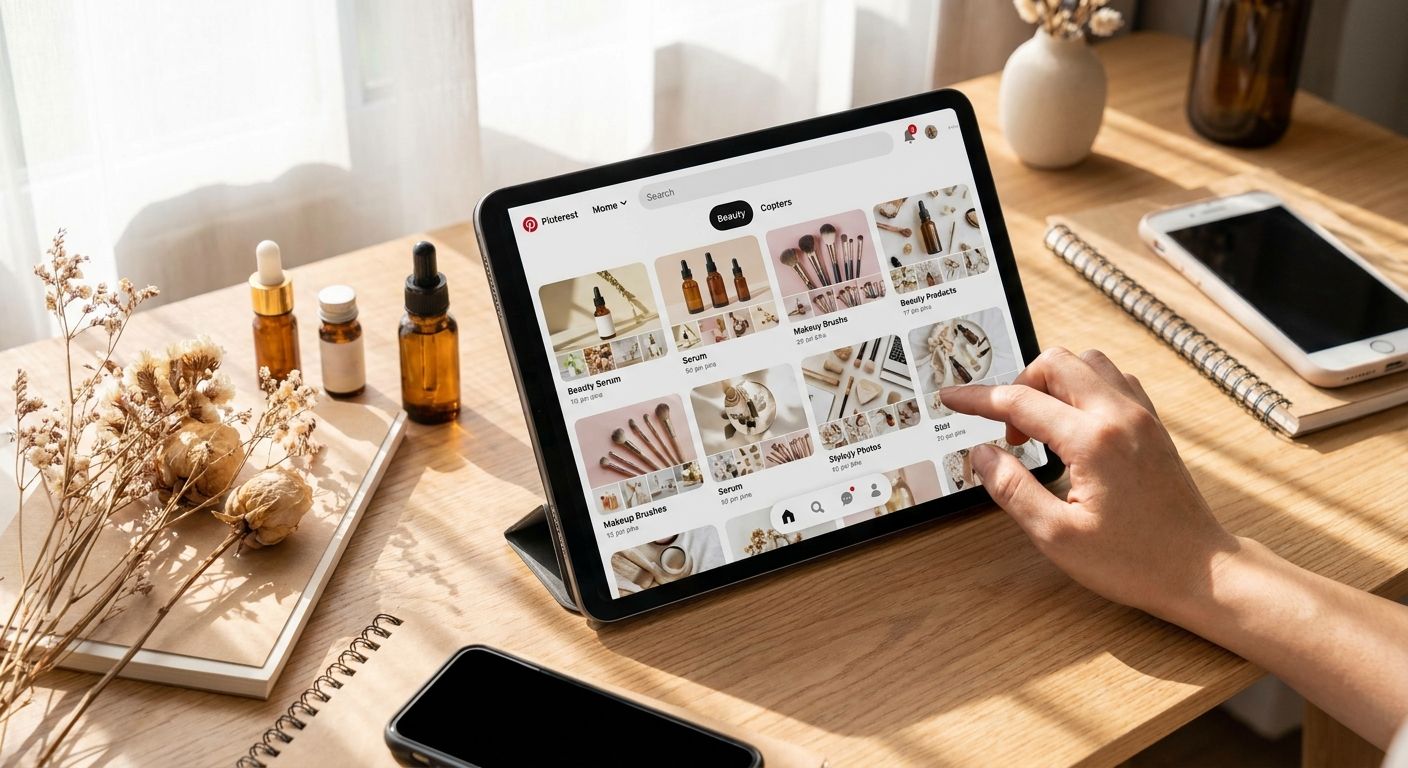
Pinterest marketing for beauty brands works when Pins get built as search content, not recycled Instagram posts — treat it as a visual search engine and it becomes one of the longest-lasting traffic channels a skincare, makeup, or haircare brand can run in 2026.
- Pinterest marketing for beauty brands wins when Pins target search intent, not just aesthetics — Buy the format.
- Video Pins and shoppable product tagging outperform static image dumps for beauty ecommerce in 2026.
- Seasonal boards built 60-90 days ahead of a launch beat reactive posting every time.
- Skip Pinterest if there's no bandwidth for SEO-driven descriptions — half-effort Pins underperform TikTok spend.
Why this matters
Most beauty brands treat Pinterest like a mood board and wonder why it never shows up in the attribution report. That's a channel-strategy problem, not a platform problem.
Pinterest behaves like Google with pictures: users search "glass skin routine" or "holiday gift set skincare" the way they'd type into a search bar, and a well-optimized Pin can keep pulling traffic for months instead of dying in 48 hours like a TikTok clip. For a beauty brand building an omnichannel presence, that longevity is the entire argument for showing up here in 2026.
Who this is for
This guide is for the beauty, skincare, or haircare marketing lead who already has a working product photography library and a Shopify or headless storefront ready to tag, and who wants a channel that compounds instead of one that resets every algorithm update. It's not for a brand with zero visual assets or one still deciding on a social platform mix — get the foundation photography and platform priorities settled first, then come back to Pinterest.
What to look for in Pinterest marketing for beauty brands
Search-first pin descriptions
A Pin description isn't caption copy — it's on-page SEO. Pinterest gives you up to 500 characters and rewards keyword-rich, specific phrasing ("vitamin C serum for dark spots" beats "our new drop") because its ranking system leans on text signals almost as much as image recognition.
Seasonal lead time
Beauty search on Pinterest runs on a planning calendar, not a reactive one — holiday gift guides, "new year skin reset" content, and summer SPF searches start climbing weeks before the actual season. A Pin published the week of a launch is already late; the winning move is publishing 60-90 days ahead of the moment it needs to rank.
Native video over static product shots
Pinterest's algorithm in 2026 pushes video Pins into more feeds than single-image Pins, and beauty content — application tutorials, before/after texture shots, unboxing — is exactly the format that performs best in motion. A static product photo on a white background gets buried next to a 15-second application demo.
Shoppable tagging setup
If product tags aren't wired into the catalog feed, every Pin dead-ends at a generic landing experience instead of the exact SKU a user was searching for. Beauty buyers on Pinterest are already in a research-to-purchase mindset — friction at that last step kills conversion that the traffic already earned.
Board architecture that mirrors buyer intent
Boards organized by routine ("nighttime skincare," "curly hair wash day") outperform boards organized by product line, because that's how the buyer is searching. Product-line boards make sense internally; they rarely match how a Pinner phrases a query.
Attribution tracking wired to the Pinterest tag
Without the Pinterest conversion tag installed and matched to Shopify or the storefront's events, none of the above gets measured, and the channel looks like it's underperforming when it's actually just invisible in reporting.
Top picks: Pinterest content plays for beauty brands in 2026
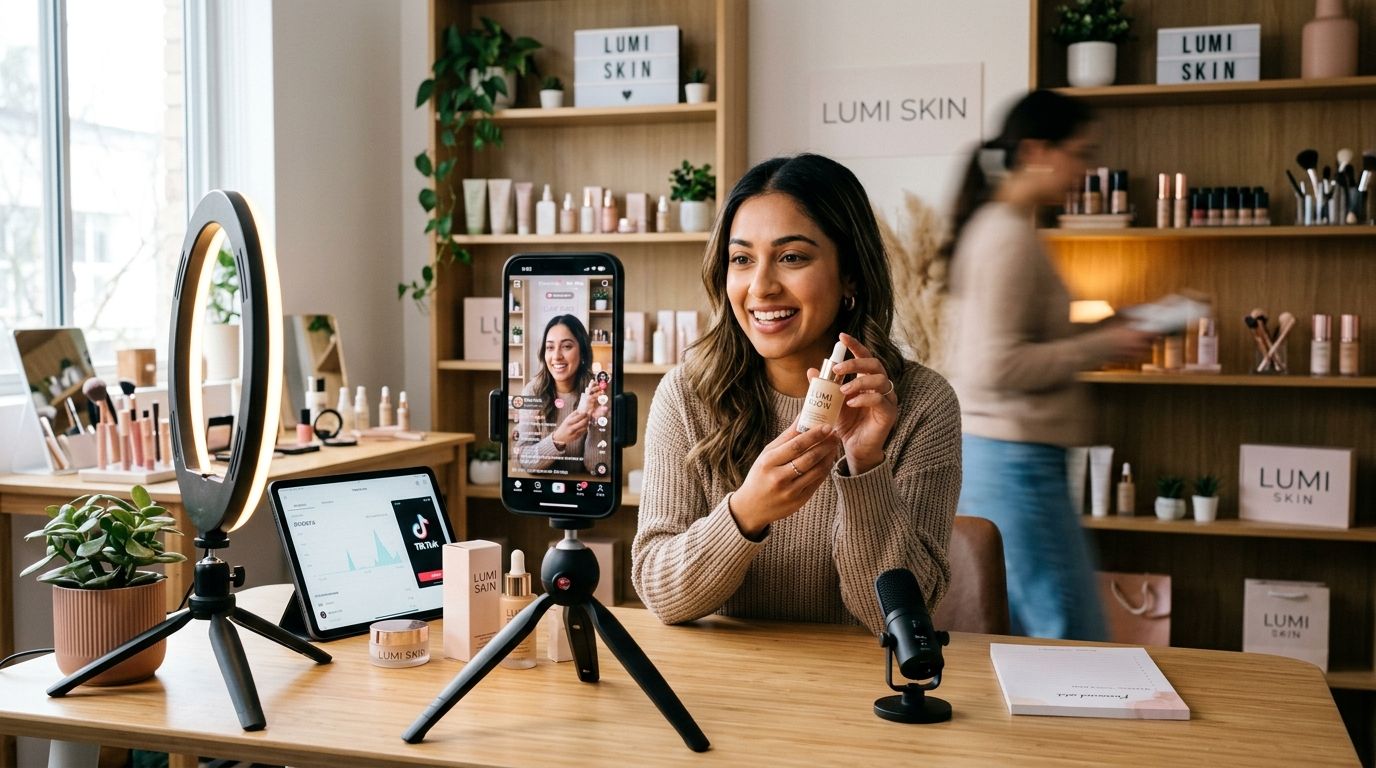
The workhorse — native video Pins for tutorials. Multi-page video Pins let a brand walk through a full routine — cleanse, treat, moisturize, SPF — in one native asset instead of a single static image. Repurposing a content creation asset already shot for TikTok into a Pinterest-native cut costs almost nothing incremental and gets a second, much longer shelf life out of the same footage. Verdict: Buy.
The conversion closer — shoppable product Pins with catalog tagging. Tag every SKU directly so a search for "niacinamide serum" lands on the exact product page, not the homepage. This is the format most tied to social commerce for beauty brands, because it collapses the search-to-checkout path Pinterest is built for. Verdict: Buy.
The planner — seasonal trend boards built 60-90 days out. Gift guides, seasonal routine swaps, and "trending in 2026" roundup boards need lead time to index before the search spike hits. Skip building these the week of the moment — they'll rank in time for next year's cycle instead. Verdict: Buy, with a calendar.
The trust signal — UGC-style Pins from real customers. Pins that look like a customer's own board, not a brand's ad unit, get saved and repinned at a higher rate because they don't read as promotional. This overlaps directly with a scaled UGC seeding motion — the same content built for that program repurposes cleanly here. Verdict: Consider, if there's already an active UGC pipeline; not worth building from scratch just for Pinterest.
The accelerant — Promoted Pins on top of organic winners. Paid spend on an already-proven organic Pin compounds faster than paid spend on a cold asset, because Pinterest's ad auction favors content with existing engagement signals. Running this blind, without an organic base to amplify, burns budget on guesswork. Verdict: Consider, only after 30-60 days of organic data exists.
Build the Pinterest play into the full mix
See how Pinterest fits an omnichannel growth plan for beauty brands.
What to avoid
- Repurposing Instagram grid posts as-is. Square lifestyle shots with no text overlay and no keyword-rich description look fine on Instagram and disappear on Pinterest, where search text does the heavy lifting.
- Boards with no more than five Pins. A sparse board signals inactivity to Pinterest's ranking system and to the human scrolling past it — under-filled boards rarely surface in search at all.
- Treating Pinterest as a traffic afterthought with no dedicated tracking. Skipping the conversion tag setup means every dollar of Pinterest-driven revenue gets misattributed to direct or organic search, which makes the channel look like a loser it isn't.
Verdict comparison table
| Content play | Best for | Lead time needed | Verdict |
|---|---|---|---|
| Native video Pins | Tutorials, routines | 1-2 weeks | Buy |
| Shoppable product Pins | Direct conversion | Ongoing (feed-based) | Buy |
| Seasonal trend boards | Gift guides, seasonal SKUs | 60-90 days | Buy |
| UGC-style Pins | Trust, save rate | Depends on UGC pipeline | Consider |
| Promoted Pins | Scaling proven winners | 30-60 days of organic data first | Consider |
FAQ
Is Pinterest marketing worth it for beauty brands in 2026?
Yes, for brands with product photography and video already in production — Pinterest functions as a visual search engine where beauty content ranks for months, not days. It's a weaker fit for brands with no content library to draw from.
How is Pinterest different from Instagram or TikTok for beauty brands?
Pinterest is search-driven and long-tail, while Instagram and TikTok are feed-driven and short-lived. A well-optimized beauty Pin can keep generating impressions for months after publishing, unlike a TikTok clip that peaks within days.
What content performs best on Pinterest for skincare and makeup brands?
Native video Pins showing routines or application steps outperform static product shots in 2026, because Pinterest's algorithm favors video and beauty buyers respond to demonstration over a plain product photo.
How far ahead should a beauty brand plan seasonal Pinterest content?
Publish seasonal boards 60 to 90 days before the moment they need to rank — holiday gift guides and seasonal routine content need that lead time to index and surface in search.
Do Pinterest ads work without organic Pins already performing?
Promoted Pins perform best when amplifying an organic Pin with existing engagement, because Pinterest's ad auction rewards proven content. Running paid against a cold asset with no organic signal is closer to guessing.
What's the biggest mistake beauty brands make on Pinterest?
Reposting Instagram content as-is without keyword-rich descriptions. Pinterest ranks on text and search intent, so a Pin with no description context rarely surfaces for the searches it should win.
Does Pinterest need its own conversion tracking setup?
Yes — without the Pinterest conversion tag matched to storefront events, Pinterest-driven revenue gets misattributed to other channels, which makes the platform look underperforming when it isn't being measured at all.
How many Pins does a board need to rank well?
Boards with fewer than five Pins signal inactivity to Pinterest's ranking system. A board built around a specific routine or occasion needs enough volume to look active and complete to both the algorithm and the searcher.
One last thing
The brands winning on Pinterest in 2026 aren't the ones posting the most — they're the ones who wrote descriptions like they were writing meta descriptions for Google, months before the season they were targeting even started.